
Watch a quick walkthrough or book a demo
Request successful.
Our team will contact you within one business day.
Pick a time that works for you and we'll send the invite.
Oops! Something went wrong while submitting the form.
Sign-up successful!
Check your inbox for a link to activate your free Perdoo account.


Henrik van der Pol
6
min
read
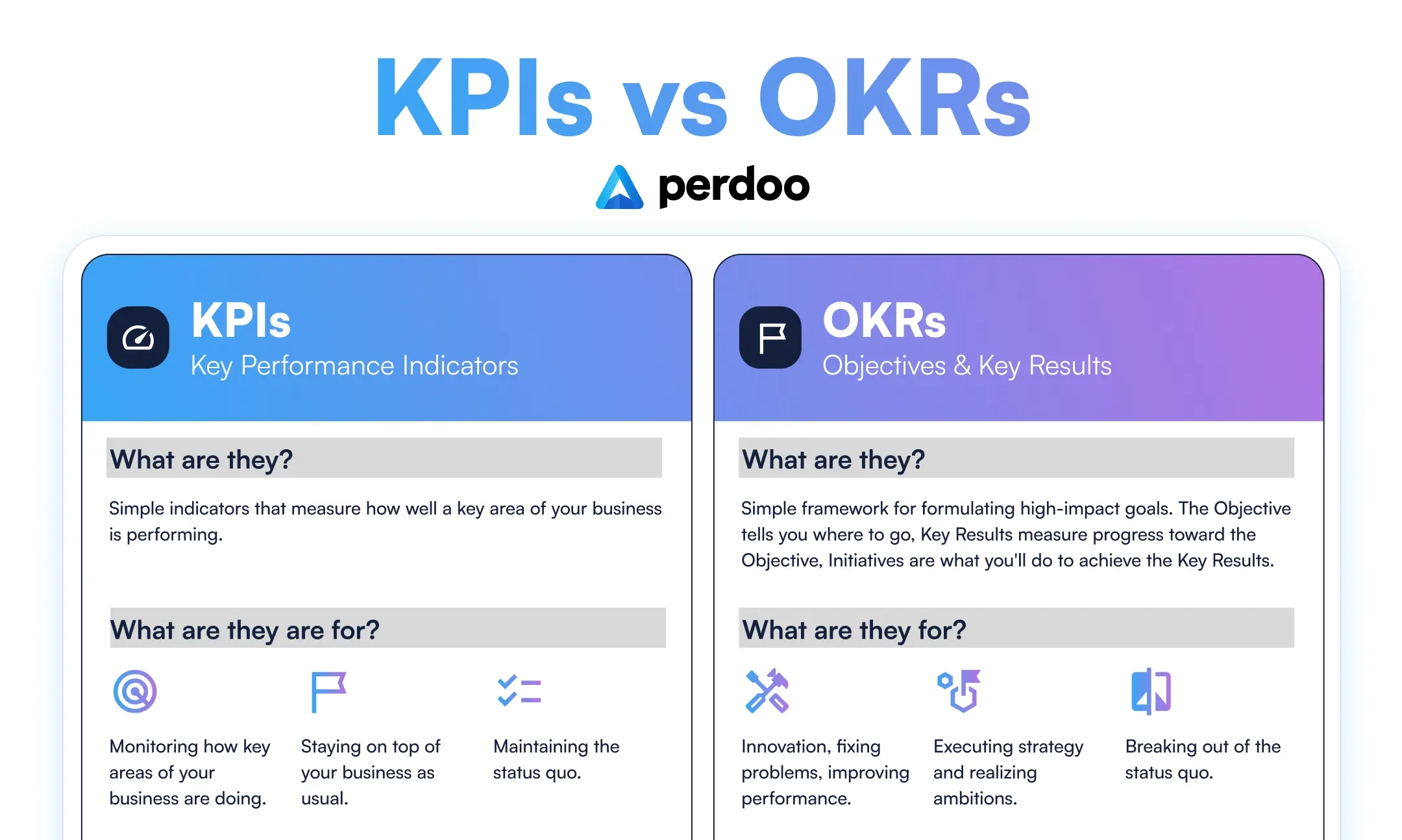
Key takeaway: Every organization needs goals to realize its strategy and ambitions. KPIs and OKRs are two different types of goals, which help you bridge the gap between today's reality and your desired future. OKR stands for Objectives and Key Results, KPI stands for Key Performance Indicator. Where OKRs are a great tool to fix problems and drive improvements, KPIs are perfect for monitoring business as usual. You'll need both to propel your company to greatness.
In this article, I'll explain what OKRs and KPIs are, how they differ, and how working with both of them together will help you unlock the full potential of your organization. Our numerous examples and powerful car analogy will help you tackle this topic once and for all.
What are OKRs and KPIs?
Before I explain the difference, let's first revisit what OKRs and KPIs are.
[fs-toc-omit]What is an OKR?
An OKR consists of 2 components: an Objective with one or more Key Results.
The Objective tells you where to go. Key Results are the results that you need to achieve to get to your Objective.
You'll often also see Initiatives associated with OKRs. Initiatives are all the things you will do to achieve your Key Results. They are all the projects and tasks that people work on that will (hopefully) drive progress for your Key Results. Initiatives are often confused with Key Results. If you need a refresher, this explanation will clarify the difference.
OKRs can be used to build, improve or innovate:
- Build: Create something that didn’t exist before.
- Improve: Make something that already exists better.
- Innovate: Reinvent something that already exists.
As such, OKRs always change from quarter to quarter and from year to year. Once you've realized the improvement or innovation, you'll focus on the next big thing that will get you closer to your organization's ultimate goal.
[blue-cta-free-perdoo-account]
[fs-toc-omit]Example OKRs

OBJECTIVE
Provide the best possible experience when people trial our software
KEY RESULTS
- Increase Net Promoter Score during trial from X to Y
- Increase Trial-to-Customer conversion rate from X% to Y%
OBJECTIVE
Empower our users to be more self-sufficient
KEY RESULTS
- Reduce incoming support tickets by X%
- Increase conversations resolved by AI by Y%
- Maintain CSAT at 95%
[fs-toc-omit]What is a KPI?
While OKRs are relatively new, KPIs have been around for almost a century. As such, almost every organization around the world is using them (although they often don't always realize this).
A KPI (sometimes also called health metric) consists of a metric with a desired target value:
- The metric (eg, NPS, Monthly Active Users, or Revenue) is what makes the KPI measurable.
- The target value is the minimum or maximum value that you want that metric to have.
KPIs are the perfect tool to monitor the health of your business as usual.
There are many different types of KPIs, and choosing the right ones depends on factors like which industry you’re in and the maturity of your organization. Each department or team will use different KPIs to measure success.
Because KPIs have been around for so long, many industry standards have evolved for both businesses as well as teams as to which KPIs to track.
[fs-toc-omit]Example KPIs
Marketing
- Visitor to Lead conversion rate ≥ 8%
- Cost per Lead ≤ $50
- Customer Aquisition Costs ≤ $2,500
Sales
- Close $X million this quarter
- Lead to Customer conversion rate ≥ 5%
- Average Time to Close ≤ 30 days
Support
- Median Response Time ≤ 20 m
- Average Resolution Time ≤ 12 hrs
- Customer Satisfaction Score ≥ 95%
What's the difference between OKRs and KPIs?
OKRs and KPIs are different types of goals that serve different purposes.
OKRs provide the missing link between ambition and reality. They help you break out of the status quo and take you into new, often unknown territory.
KPIs, on the other hand, measures the success of ongoing processes and activities — also known as your business as usual. They monitor how well important parts of your business are performing.
The following analogy will help you understand the difference once and for all.
The car analogy
Let’s imagine your organization is a car and you’re driving that car toward your destination. That destination is your organization's ultimate goal.
OKRs will help you map out a road toward your destination. They are like your landmarks. That's why OKRs continuously change: once you've passed a certain landmark, you'll be focusing on the next.
KPIs are what you find on your car’s dashboard, like your fuel gauge and temperate gauge. These are the things you’ll need to constantly watch to ensure, for example, that your engine isn’t overheating and that you aren't running out of gas. No matter where you are on your journey.

Cheat Sheet KPIs vs OKRs
Download our Cheat Sheet KPIs vs OKRs
Why you need OKRs and KPIs
An organization needs both KPIs and OKRs.
If you're only watching KPIs, you would mostly be maintaining the status quo. It would simply be a matter of time before a competitor will take your business. We all know examples of companies and products that stopped building, improving, and innovating — eventually they'll cease to exist.
Only watching OKRs is equally risky. You wouldn't notice that you're about to run out of gas (or battery power), and without gas left in the tank you won't get very far either.
To be a truly results-driven organization, you need both OKRs and KPIs. KPIs monitor the performance and identify problems and areas for improvement; OKRs help solve problems, improve processes, and drive innovation.
If you're looking for a tool that handles both, see how Perdoo's OKR software manages OKRs and KPIs side by side.
A real-life example
Curious to see how OKRs and KPIs work together in real-life to help an organization succeed? We've opened up our own Perdoo account so you can take a look. You can access it here (link must be opened in an incognito tab if you already have a Perdoo account).
Synergies & Conflicts
There are great synergies between OKRs and KPIs. At the same time, you shouldn't be tracking your business as usual with OKRs, nor should you boost the ambition of your KPIs without supporting them with OKRs.
Let's take a look at the synergies first.
[fs-toc-omit]Synergies
An OKR can become a KPI, and an OKR can also be used to improve a KPI. In other words, the two work well together. The best way to illustrate how this works is through an example.
Let’s say that critical business as usual for your support team is to answer incoming support tickets as soon as possible. You agree that, on average, tickets should be answered within 30 minutes. You create a KPI in Perdoo that measures the average reply time for incoming support tickets. Example KPI: Average response time ≤ 30mins.
As long as the KPI indicates an average reply time of 30 minutes or less, you know you’re on track. But what if the KPI indicates the average reply time currently is 52 minutes? You probably want to create an Objective to fix this.
In order to create the right Key Results for this Objective, you’ll need to investigate what exactly caused the average reply time to rise. Perhaps you’ve onboarded a lot more customers recently but don’t have enough support agents. Or perhaps you released new features without creating support articles for them in your Knowledge Base.
If the reasoning is the latter, you could create the following OKR (and align it to your KPI):
OBJECTIVE
Empower customers to help themselves by building the best help resources
KEY RESULTS
- Reduce the number of support tickets by X%
- Increase Knowledge Base traffic to X unique visitors
[fs-toc-omit]Conflicts
KPIs and OKRs are two different types of goals that each serve a different purpose. KPIs are a great tool for monitoring business as usual, OKRs are perfect for fixing problems and driving improvements.
When you're creating an OKR to monitor your business as usual, you'll see that you end up with pretty much the same OKRs each quarter and year. That makes little sense and creates unnecessary overhead for your team or organization. When this happens, you'll also often see that team members start questioning the value of OKR. After all, weren't KPIs good enough for this purpose? (Hint: Yes, KPIs are even better for this purpose.)
Similarly, when you're pushing improvements across the organizations only by increasing (or decreasing) the target values of your KPIs, you'll quickly see these KPIs turn unhealthy. As mentioned, OKRs are a great goal type to realize improvements. So when you're increasing the ambition of a KPI, create an OKR to help you realize this new, more ambitious target for your KPI.
Common OKR and KPI mistakes to avoid
- Migrating from KPIs to OKRs
As explained above, you need both KPIs and OKRs. KPIs monitor the performance of your business as usual whereas OKRs help identify the most important problems to solve. - Ignoring KPIs because you want to implement OKRs first
Some companies don't realize that they already work with KPIs. They think it's new for their organization, even though — for example — the executives keep a close eye on things like revenue, profit, and turnover (all valid KPIs). I would even argue to get your KPIs in place first, before implementing OKR. After all, you can't really drive a car without a dashboard. But KPIs are also an important input when setting OKRs: when one of your KPIs is unhealthy, you should make it a priority to improve that KPI and that's what you can use an OKR for (which is why, in Perdoo, you can align OKRs to KPIs). Lastly, having your KPIs in place first also helps everyone understand what OKRs are for (see next point). - Using OKRs to measure everything
When you're ending up with OKRs that are pretty much the same every quarter, it's a sign that you're using OKRs to (also) measure your business as usual. Business as usual should be measured with KPIs: simple indicators that immediately tell you if an important part of your business is healthy or not (see Conflicts above). OKRs should also not be used to measure everything you do. They're really designed to surface the most important problems to fix and improvements to make, and keep everyone focused on just these priorities.
Watch video

Ready to get started?
Free for up to 5 people.