
Sign-up successful!
Check your inbox for a link to activate your free Perdoo account.
Watch a quick walkthrough or book a demo
Request successful.
Our team will contact you within one business day.
Pick a time that works for you and we'll send the invite.
Oops! Something went wrong while submitting the form.


The Ultimate Guide to Strategy
15
min
read
Introduction
Introduction to strategy and strategy execution
Every organization, regardless of size or structure, needs a strategy. However, more often than not, strategy is misunderstood and used incorrectly. Strategy and organizational effectiveness are very different, and therefore it’s important to truly understand what strategy is all about to ensure you’re working with it correctly in order to help your organization succeed.
In this guide, we'll break down the essentials of strategy and strategy execution, the difference between strategy and planning, what it means to create a good strategy, how to execute it with OKRs and KPIs, and how you can manage it efficiently using Perdoo.
Why it matters
The importance of strategy and execution
The importance of strategy execution cannot be overstated in the business world. Without strategy, an organization is like a rudderless ship navigating in turbulent waters. Efforts can often have unclear direction, rendering them inefficient and potentially futile. However, a well-crafted strategy serves as a blueprint for your business, ensuring that every member of your organization understands their role, aligns their efforts with the overarching strategy, and contributes to collective success.
It is through meticulous execution that these aspirations become a reality. Moreover, successful execution provides a continuous feedback loop, allowing organizations to adapt to changing circumstances and refine their approach. In essence, strategy execution is the bridge between strategic intent and concrete results, making it a crucial driver of sustainable growth, competitive advantage, and overall organizational excellence.
But what is strategy all about? Let’s take a deep dive into what strategy really is.
What is strategy?
Strategy is a military term and comes from the Greek words “stratos” (army or resources) and “ago” (leading). In a military context, strategy thus means to lead your resources to win the battle. A proper business definition would be: to employ your resources to achieve your organization’s goal.
Strategy matters because each organization has finite resources and faces competition. Were resources infinite, you wouldn’t need a strategy — your company could simply do everything it wanted to. And without competitors, there wouldn’t be a need to differentiate yourself. But with limited resources and the constant threat of competition, strategy becomes critical, and (tough) choices will have to be made.
But before those choices can be made, you first need to decide which battle(s) you want to fight and what winning looks like.
The Ultimate Goal: define your playing field
Your Ultimate Goal defines the ultimate winning aspirations for your business. Which battles will you fight, and which will you leave alone? When will you consider the battle won?
A good Ultimate Goal answers 3 questions:
- What’s the purpose of your organization?
This is also called your organization’s mission. It explains why your organization was created in the first place, and which problem it is solving. - For whom is your organization fulfilling that purpose?
The problem your organization is solving potentially applies to many people and/or organizations. You can’t serve them all. Pick the (customer) segments that are most important to you. - When will you consider your venture a success?
This is often called your organization’s vision. It says a lot about what you want your organization to become, and explains when you will have won “the battle”.
Example Ultimate Goals
Here are a few examples from our clients:
- Help SaaS businesses know their customers. Be market leader in Behavioural Analytics.
- Be the leading construction company in Canada by building infrastructure that people depend on.
Perdoo’s Ultimate Goal
At Perdoo, our Ultimate Goal is to help ambitious organizations propel their growth and be the leading OKR platform in Europe and North America.
Let’s break this down:
- Our purpose is to help organizations propel their growth.
- We’re doing that for ambitious organizations in Europe and North America. While we’re honored to have customers in more than 70 countries, we’re focused on Europe and North America.
- And, we want to be the leading OKR platform in those regions. That’s what winning looks like for us.
Our answers to the 3 questions explain to everyone on our team what our playing field looks like and what it takes to win. The impact of these choices is huge. For example, while local players in lower-income countries may copy us and undercut our price, these aren’t battles worth fighting for us.
Over to you
Take this time to reflect on what winning looks like to you and what your playing field is — define your business’s Ultimate Goal.
Create a free Perdoo account and start sharing with your team what your organization is all about.
Strategic Pillars: deciding how to win
Now that we know where we’re playing and what winning looks like, it’s time to figure out how to win. Our how-to-win choices explain how we (aim to) differentiate ourselves in the market; and why customers choose us over the competition.
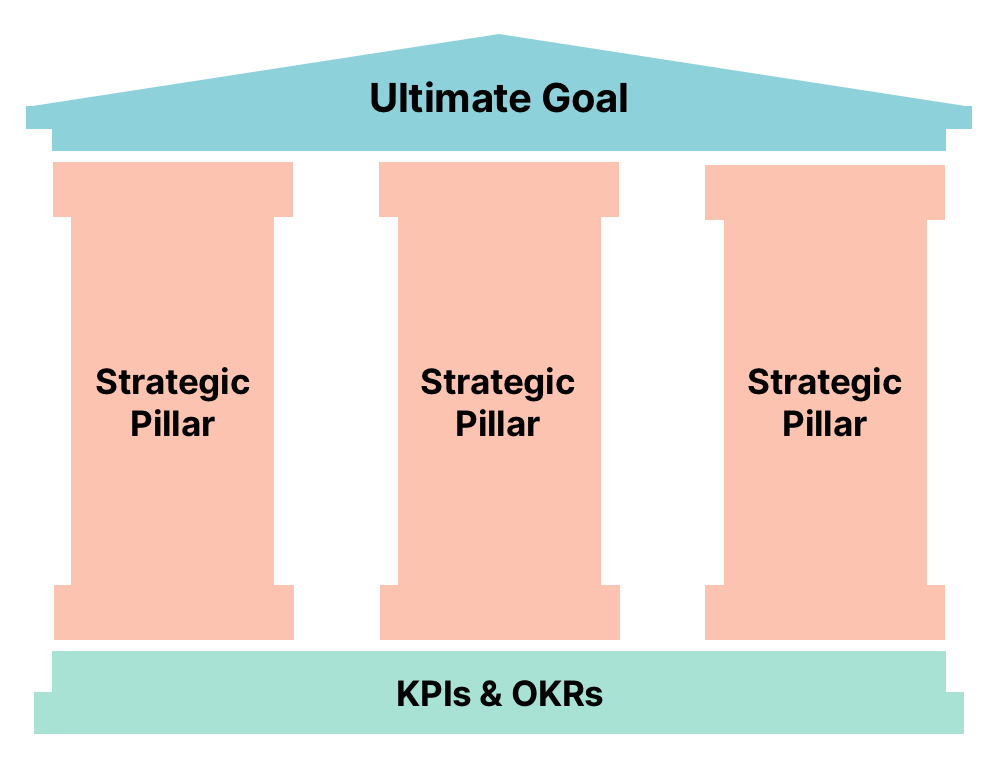
These choices are directly connected to your Ultimate Goal: they explain how to win on the chosen playing field. Change your Ultimate Goal, and you’ll have to revisit how to win on that new playing field. Your Ultimate Goal and Strategic Pillars are, therefore, jointly called your “strategy”.
Your how-to-win choices will be the pillars that will support your Ultimate Goal. You should aim to have 3 to 5 Strategic Pillars.
Example Strategic Pillars
Remember the Canadian construction company from above? Their Ultimate Goal was to be the leading construction company in Canada by building infrastructure that people depend on. These are some of their Strategic Pillars:
- Be committed to H&S and sustainability in all aspects of our work.
- Put D&I at the heart of our high-performing workforce.
- Be a company that clients love to work with.
The Ultimate Goal of the behavioral analytics company above was to help SaaS organizations know their customers and be market leaders in behavioral analytics.
Their Strategic Pillars include:
- Deliver the fastest analysis for every user.
- Be self-serve at every stage of the journey.
- Build a culture where each employee learns and thrives.
Now it’s your turn
What are the Strategic Pillars for your business? Get a free Perdoo account and start communicating your strategy in a way that everyone understands!
Putting it all together
Keep it simple — both your Ultimate Goal and your Strategic Pillars.
While it can take some time and be hard to find the right answers for your business (large enterprises pay strategy consultants like McKinsey millions in fees to help them find those answers), the questions themselves are simple and require simple answers. You’re not going to realize your organization’s Ultimate Goal all by yourself, and you’ll need the entire organization to realize your strategy. It’s therefore critical that everyone — yes, everyone — in your organization can understand it and recite it. Only then can they make sure that whatever they are working on every day, is helping your company move in the right direction.
Amazon’s founder and CEO, Jeff Bezos, is one of the masters of this art. From Eugene Wei, who worked on the product there: “What stands out is that I can recite these from memory even now, over a decade later, and so could probably everyone who worked at Amazon those years.”
According to research by Kaplan & Norton, 95% of a company’s employees are unaware of, or do not understand, its strategy. Kaplan & Norton: “If the employees who are closest to customers and who operate processes that create value are unaware of the strategy, they surely cannot help the organization implement it effectively.”
Fix this, and you’re miles ahead of your competition.
Criteria for a good strategy
Now that you know what strategy is all about and are working toward defining your organization’s strategy, here are a few things you should keep in mind to ensure your strategy serves you well.
Here are the 3 most important criteria. A good strategy is:
- One that you plan to execute.
This sounds like a joke but it isn’t. Many companies will have a strategy along the lines of ‘Be a great place to work’. I think this can be a good strategy to have — if you’re able to attract and retain better talent than your competitors, your chances of succeeding will be higher. But how many businesses are making all the required investments to become — and remain — a great place to work? My guess is not many.
When choosing a strategy, make sure you’re seriously planning to execute it. A strategy can only pay off when it’s executed and don’t underestimate the amount of work that will go into that.
The best way to ensure this is to make your strategy measurable. You create Key Results to measure the success of your Objectives, you should create KPIs to measure the success of your strategy (this is why you can align KPIs to strategy in Perdoo). As the saying goes “If you cannot measure it, you cannot improve it.”
- One that you can execute.
Every organization has different ambitions, resources, and circumstances. If you don’t take these factors into account, you’re setting yourself up to fail.
For example, how much capital do you have access to? Are you willing to fundraise? At Perdoo, we decided against taking on venture capital. This decision had consequences for our strategy. Instead of spending (wasting?) lots of venture dollars on Google Ads, we focused on creating high-quality resources and offering them for free to the market (offer the best resources and support is still one of our Strategic Pillars today). While it’s probably easier to raise venture capital and buy your way to the top of Google search results, it just didn’t feel like a useful way to use our talents. More importantly, because we didn’t have huge budgets, growing aggressively through paid advertising wasn’t an option for us.
What also helped is that we were early in the market. Therefore, it was easier then, than it is now, to rank high organically for relevant search terms. Many people also started sharing our content so we knew we were doing something well — we knew we were able to execute our strategy to offer the best resources and support. It was different for our competitors. For some of them, raising venture capital was a better strategy, since their circumstances are/were different.
When setting a strategy, you need to know your organization inside out. You need to know which resources you can — and want to — obtain, and which resources you’ll have to do without. Only then can you be sure that you can actually execute it.
- One that exploits your strengths.
A good strategy utilizes the strengths of a business. It’s for good reason that a SWOT analysis is a popular activity during strategy offsites.
What do you believe you can — or should — be better at than any other player in the market? Do these strengths already exist? Or could you commit to building these up? Do these strengths have the potential to help you realize your Ultimate Goal?
Going back to the example above, we were getting signals from the market that they appreciated our content. At the same time, we were getting many questions from people trialing our product. They didn’t ask so much about how to use our product, instead, they had many theoretical questions about how to use strategy, KPIs, and OKRs to power their business. So we knew that we would be able to create better resources than the competition, and we also knew this was something the market needed.
That’s it. In summary, make sure that your strategy is one that you plan to execute, one that you can execute, and one that exploits your strengths, and your strategy will give you sustainable advantages over your competitors.
Strategy vs. planning: What’s the difference?
Strategy and planning are terms that are often used interchangeably. However, they’re very different and should not be confused. And therefore, strategic planning does not equate to strategy either. Here’s why.
The key distinction between strategy and planning lies in their inherent characteristics and outcomes. Strategy is the art of making clear choices. It is the overarching blueprint defining what the company stands for, that drives company-wide efforts. Consider a company deciding to differentiate itself through innovation or cost leadership in a competitive market. The choice to pursue innovation represents a strategic decision that sets the company apart. Planning, on the other hand, is akin to a step-by-step approach, involving the development of detailed processes to achieve specific objectives. For instance, an annual budget or project timeline represents planning, where predefined steps are meticulously laid out.
While planning may provide the roadmap to implement the chosen strategy, the essence of strategy lies in the thoughtful selection of a path that gives an organization a sustainable advantage over competitors. In summary, strategy is about making distinct choices that shape an organization's direction and planning is about execution and taking well-thought-out steps.
An overview of the difference between strategy and planning:
Strategy:
- Involves making choices to achieve specific goals.
- Focuses on creating a unique and sustainable advantage.
- Adapts to changes and uncertainties in the environment.
Planning:
- Deals with the steps and processes to achieve predetermined objectives.
- Is more operational and short-term.
- Follows a predefined path without emphasizing choice-making.
How is strategy executed?
Executing strategy effectively involves the structured use of goals, such as Objectives and Key Results (OKRs) and Key Performance Indicators (KPIs). OKR is a powerful framework for translating your strategy into actionable and measurable outcomes. Once you have your Ultimate Goal and Strategic Pillars defined, it’s easy for the organization and teams to identify and set clear objectives that align with their overall strategy and break them down into specific, measurable, and time-bound key results. In doing so, you ensure that every team member understands the strategic priorities and can contribute to their achievement.
KPIs, on the other hand, act as measurable metrics that directly reflect the success of specific actions outlined in the strategy. By tracking KPIs, organizations can gauge their progress and make informed decisions to adjust their strategy if necessary.
Let’s give you the example of Perdoo.
Our Ultimate Goal is: “At Perdoo, our Ultimate Goal is to help ambitious organizations propel their growth and be the leading OKR platform in Europe and North America.” One of our Strategic Pillars is: “Be a great place to work.”
A KPI to measure the ongoing success of this Strategic Pillar for example is “Employee NPS ≥ 30.” This way it’s easy for us to keep a finger on the pulse to ensure our employees are satisfied. If the number drops below the target, we’re aware that changes need to be made. An example of a quarterly OKR aligned to this Strategic Pillar in Q3 2023 was “Build out Learning and Development policy to support individual career growth.”
Overall, the combination of OKRs and KPIs provides a robust system for executing strategy and fostering alignment, accountability, and adaptability throughout the organization. In doing so, it not only provides a roadmap for strategic execution but also offers a dynamic feedback loop for continuous improvement.
The right strategy execution software makes this process systematic rather than ad hoc.
Perdoo strategy execution process
Now that you know the ins and outs of strategy and what execution looks like, it’s critical to create a loop of continuous success. We call this loop the strategy execution flow:

Once you have your strategy (Ultimate Goal and Strategic Pillars) defined and set up, at the beginning of a year or quarter, the next thing to do is to define your company and team KPIs. Company KPIs should be added to the Strategic Pillars to communicate and detail what success for each Pillar means. Team KPIs should be set up to ensure teams are keeping track of important metrics and processes that ensure the company is continuously heading in the right direction.
Next up are OKRs. By closely reflecting on your strategy, in your annual OKR cadence, set Company OKRs that mirror the 3 to 5 big themes for your organization for the coming year. Teams can then create quarterly OKRs that align with Strategic Pillars and Company OKRs. These are the OKRs that all your teams are working on every day and every week, to push the organization in the right direction. These often need to be drafted, approved, and if needed refined by leadership to ensure efforts across the organization are in line with the company’s strategic intent.
Once you have this groundwork ready, this is where the execution fun begins! It’s essential to check in on your goals regularly — we recommend weekly — to share wins, challenges, and progress with teams and coworkers. By doing so you increase the chances of achieving more goals as you ensure you’re not just setting and forgetting the goal, but instead keeping it top of mind and actively working on the goals you and your teams have deemed most important. Additionally, use 1:1 meetings to regularly collaborate on work, keep track of critical action items, and exchange feedback when needed.
At the end of each timeframe, it’s good to run a retrospective of how your goals progressed through the year or quarter. In Perdoo this usually takes place when closing your OKRs. This is an important exercise to reflect on the execution of the goals and document any learnings that may have occurred. Doing so helps you adjust your efforts moving forward and provides a clearer picture for future prioritization of work and goals.
That’s the strategy execution flow — all you have to do is repeat it!
How it all comes together in Perdoo
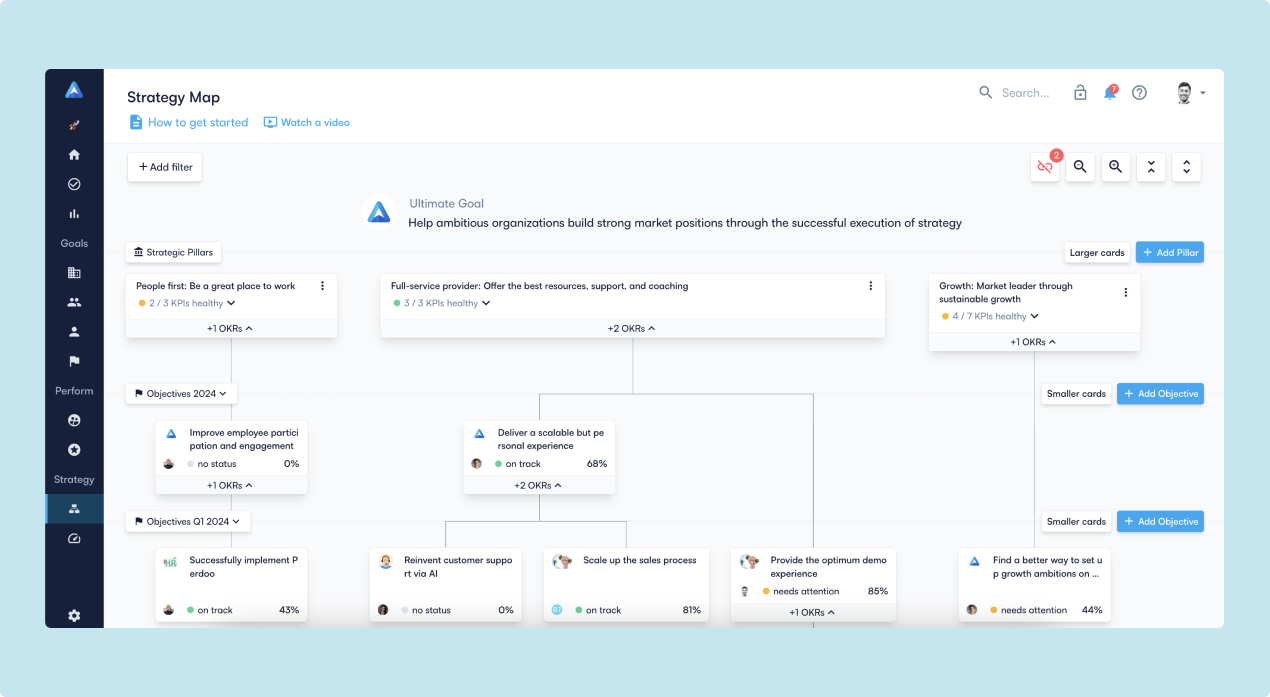
Perdoo is built for strategy execution and everything comes together on the Strategy Map. This is your source of truth, fostering strategic alignment as everyone starts pulling in the same direction, focused on what matters most: delivering the strategy. It places your organization’s Ultimate Goal and Strategic Pillars right at the top, visualizing your strategic choices and communicating your strategy in a way that's understood by everyone. Teams can then align OKRs to the strategy, deciding how best they can contribute to it while spotting opportunities for horizontal alignment.
[fs-toc-omit]Eager to get started?
Create your free Perdoo account here! 🚀
[fs-toc-h2]FAQ
[fs-toc-omit]Frequently Asked Questions
What is an OKR?
OKR stands for Objectives and Key Results. The Objective is a clearly defined goal, and the Key Results are specific measures used to track the achievement of that goal. OKRs are typically used at an organizational, team, and individual level.
What is a Key Performance Indicator (KPI)?
A Key Performance Indicator (KPI) is a measurable value that demonstrates how effectively a company is achieving its key business objectives. KPIs are used by organizations to evaluate their success in reaching specific targets across various aspects of their operations. They serve as a valuable tool for decision-makers to identify areas of improvement and allocate resources efficiently. KPIs can be used at various levels within an organization, from high-level strategic goals to departmental or individual performance. To be effective, KPIs should be: 1. Specific: KPIs should be clearly defined, with a particular focus on the desired outcome.2. Measurable: KPIs should have quantifiable metrics that can be tracked over time.3. Achievable: KPIs should be realistic and attainable within the given resources and constraints.4. Relevant: KPIs should be aligned with the organization’s overall goals and objectives.5. Time-bound: KPIs should have a specific time frame for achieving the desired outcome. Some common examples of KPIs include revenue growth, customer satisfaction, employee retention, and operational efficiency. By monitoring these indicators, organizations can make informed decisions and take necessary actions to remain competitive in the market and achieve long-term success.
Why is it important to use both OKRs and KPIs?
Using both OKRs and KPIs provides a balanced view of organizational performance. While KPIs are great for measuring ongoing performance and operational efficiency, OKRs allow organizations to set, track, and achieve ambitious goals. This combination allows for both short-term and long-term planning and assessment.

Ready to get started?
Free for up to 5 people.