
Sign-up successful!
Check your inbox for a link to activate your free Perdoo account.
Watch a quick walkthrough or book a demo
Request successful.
Our team will contact you within one business day.
Pick a time that works for you and we'll send the invite.
Oops! Something went wrong while submitting the form.


OKR Examples: 100+ Real-World Objectives and Key Results
15
min
read
Writing good OKRs can be the simple make-or-break of a successful OKR program. While we’ve written a lot about how to write great OKRs to help you get started with the OKR setting process, having tried and tested OKR examples as inspiration and guidance makes a world of difference.
This OKR examples guide is your one-stop shop to ensure your company and team OKRs are on the right path and are set up for success.
Introduction
How this OKR examples guide can help you
This guide provides clear, specific examples that help streamline the process of setting effective OKRs. Having well-defined OKRs not only helps you stay organized but also eliminates the risk of haphazard goal-setting. When your OKRs are aligned and concrete, you create a clear path for everyone involved, keeping the whole organization focused and productive. Specific examples (like the ones we’ve provided) give you something tangible to model your own goals after, reducing ambiguity and boosting alignment across teams.
Each department and industry operates differently. That’s why we’ve created a variety of OKR examples tailored to different functions, from Marketing to HR to Engineering. Whether you're in Sales or Customer Service, you’ll find examples that speak directly to your team's priorities, allowing you to adapt these frameworks to suit your unique needs.
[blue-cta-leading-software-okr]
Objectives & Key Results
OKR components
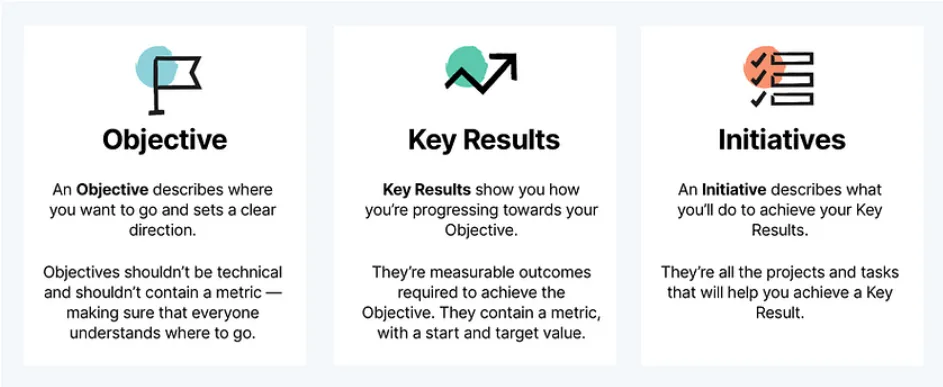
Objectives and Key Results (OKR) is a goal management framework that helps organizations bridge the strategy-execution gap by bringing your people and the work they do together toward achieving a common Objective.
An OKR consists of the following components:
Company OKRs
What is a Company OKR?
Company OKRs (Objectives and Key Results) set the direction for the entire organization and are typically set annually. These OKRs serve as a guiding framework, ensuring that every team and department aligns their efforts with the organization's most critical priorities. A well-crafted Company OKR should reflect the 3 or 4 essential goals that your organization must achieve over the next 12 months to drive growth, innovation, or operational excellence.
To be effective, these objectives should be ambitious yet achievable, inspiring the entire organization to push toward success. Key Results, which accompany each objective, should be measurable and time-bound, providing a clear benchmark for progress and success.
Example Company OKRs
Example Company OKR 1
Objective: Create a more goal-oriented company culture
- Key Result 1: Ensure 90% of Key Results are reviewed and updated every 2 weeks.
- Key Result 2: Achieve 85% of all set Objectives by year-end
- Key Result 3: Conduct quarterly workshops on OKR best practices with at least 80% employee participation
Example Company OKR 2
Objective: Solidify our finances to set the stage for taking our product to the next level
- Key Result 1: Increase gross profit margin from 30% to 40%
- Key Result 2: Generate €20M in revenue by the end of the fiscal year
- Key Result 3: Reduce operating expenses by 10% while maintaining current service levels
Example Company OKR 3
Objective: Crush the competition through acquisitions
- Key Result 1: Successfully acquire 3 key competitors
- Key Result 2: Integrate acquired companies’ operations within 6 months post-acquisition, achieving 100% operational efficiency
- Key Result 3: Increase market share by 15% in each of the new markets entered through acquisitions
Team OKRs
What is a Team OKR?
Team OKRs (Objectives and Key Results) express the specific tactics and initiatives that teams and individuals will implement to contribute to the organization’s overarching goals. These OKRs break down the company OKRs into actionable steps ensuring that each team is working toward realizing the companies’ long-term Objectives.
Typically set on a quarterly basis, Team OKRs allow for a more agile approach to goal-setting, enabling teams to adapt and pivot quickly if their strategies are not effectively driving progress toward the Company OKRs. This quarterly cadence ensures that teams can remain responsive to changes in the market, customer needs, or organizational priorities.
Team OKRs are also a critical tool for fostering cross-functional collaboration, as they often require coordination between different departments to achieve the desired outcomes. Regularly reviewing and adjusting these OKRs is crucial for maintaining alignment and momentum throughout the organization.
Now that we've covered what a Team OKR is, from here onwards you'll find OKR examples for different departments — keep reading to discover how to apply these principles in your own team!
Marketing OKRs
Example Marketing OKRs
Marketing teams are responsible for promoting the company’s products or services, driving brand awareness, and generating leads. OKRs in Marketing are critical for setting clear goals around customer engagement, digital growth, and campaign effectiveness. By aligning their efforts with measurable outcomes, Marketing teams can focus on improving customer experiences, expanding their audience, and boosting the company’s visibility in key markets.
Example Marketing OKR 1
Objective: Improve customer experience on our website
- Key Result 1: Achieve an exit survey CSAT score of over 85%
- Key Result 2: Increase the average cart value by 15%
- Key Result 3: Increase the percentage of monthly returning customers from 10% to 15%
Example Marketing OKR 2
Objective: Expand our Instagram footprint through influencer partnerships
- Key Result 1: Increase Instagram followers from 100,000 to 1 million
- Key Result 2: Generate 5,000 qualified leads from influencer posts
- Key Result 3: Collaborate with 20 influencers who each have over 500,000 followers
Example Marketing OKR 3
Objective: Strengthen our SEO ranking for "affordable beauty"
- Key Result 1: Improve domain authority from 40 to 60
- Key Result 2: Achieve a top 3 ranking for 10 high-volume keywords related to "affordable beauty"
- Key Result 3: Increase organic traffic from search engines by 30%
[d-ebook-okr-marketing-teams]
Sales OKRs
Example Sales OKRs
Sales teams are responsible for driving revenue by acquiring new customers and growing relationships with existing ones. OKRs are a crucial part of a sales enablement toolkit as they provide measurable goals that help teams maintain and stay on top of a strong pipeline, close deals, and boost recurring revenue. By setting ambitious, yet attainable targets, Sales can stay aligned with overall business objectives and contribute to sustainable growth.
Example Sales OKR 1
Objective: Build a healthy and sustainable Sales pipeline
- Key Result 1: Achieve a monthly pipeline of $1M in qualified leads
- Key Result 2: Secure 23% of total deals as "Enterprise" deals
- Key Result 3: Increase total enriched leads from 60% to 75%
Example Sales OKR 2
Objective: Turn our partner network into a revenue stream
- Key Result 1: Generate $500K in partner revenue
- Key Result 2: Acquire 20 new customers from partner referrals
Example Sales OKR 3
Objective: Accelerate Recurring Revenue
- Key Result 1: Increase subscription revenue to $1M
- Key Result 2: Increase monthly recurring revenue (MRR) by 5% each quarter
[d-ebook-okr-sales-teams]
Customer Service OKRs
Example Customer Service OKRs
Customer Service ensures customers have a positive experience, resolving issues, and providing support. OKRs for Customer Service help teams focus on improving key metrics such as customer satisfaction (CSAT), response times, and proactive engagement. Well-defined OKRs empower Customer Service teams to build efficient support systems, reduce churn, and enhance customer loyalty.
Example Customer Service OKR 1
Objective: Empower customers to help themselves by building the best help resources
- Key Result 1: Reduce the number of support tickets by 25%
- Key Result 2: Increase support center traffic to 100,000 unique visitors monthly
Example Customer Service OKR 2
Objective: Create a world-class customer support experience
- Key Result 1: Achieve a CSAT score above 98%
- Key Result 2: Reduce first response time to under 4 hours
- Key Result 3: Decrease average resolution time by 15% within 6 months
Example Customer Service OKR 3
Objective: Transition from a reactive to a proactive customer strategy
- Key Result 1: Reduce customer churn risk by 20%
- Key Result 2: Decrease complaints by 30% within the next 6 months
[d-ebook-okr-customer-teams]
Human Resources (HR) OKRs
Example HR OKRs
Human Resources (HR) manages the people side of the business, from recruitment to employee well-being. OKRs are essential in HR to streamline hiring processes, foster a healthy work environment, and promote employee development. Clear goals help HR teams measure and improve the recruitment pipeline, employee satisfaction, and professional growth initiatives.
Example HR OKR 1
Objective: Introduce the right candidates to teams sooner
- Key Result 1: Reduce time from application to HR screen from 10 to 5 days
- Key Result 2: Decrease time from HR screen to first interview from 7 to 3 days
Example HR OKR 2
Objective: Make work-life balance a priority for all employees
- Key Result 1: Improve work-life balance survey score from 70% to 85%
- Key Result 2: Reduce overtime by 15%
- Key Result 3: Increase weekly pulse survey score from 60 to 75
Example HR OKR 3
Objective: Foster a learning culture to support our employees' professional development
- Key Result 1: Increase skill certifications by 25%
- Key Result 2: Improve performance review learning score from 70% to 90%
Product OKRs
Example Product OKRs
The Product team is tasked with building and refining the company's offerings, ensuring they meet customer needs. OKRs enable Product teams to set clear Objectives around feature utilization, user experience, and product development efficiency. This alignment helps teams prioritize improvements and deliver products that drive business growth.
Example Product OKR 1
Objective: One step effortlessly leads to the next in our product user journey
- Key Result 1: Achieve 60% utilization of new features
- Key Result 2: Increase feature X usage by 20%
Example Product OKR 2
Objective: Reimagine the product development process to make it more predictable
- Key Result: Increase on-time deployments from 60% to 85%
Engineering OKRs
Example Engineering OKRs
Engineering teams build and maintain the technological foundation of the company. OKRs are vital for Engineering to set targets for productivity, code quality, and problem resolution speed. By using OKRs, Engineering teams can focus on improving processes, reducing bugs and defects, as well as delivering high-quality work faster.
Example Engineering OKR 1
Objective: Our engineering team has never been so effective
- Key Result 1: Reduce cycle time by 30%
- Key Result 2: Improve Point Commitment Reliability from 70% to 90%
- Key Result 3: Increase Defect Removal Efficiency from 50% to 75%
Example Engineering OKR 2
Objective: Speed up deployment of important bug fixes
- Key Result 1: Reduce time to fix bugs from 7 days to 3 days
- Key Result 2: Reduce client complaints related to bugs by 20%
Operations OKRs
Example Operations OKRs
Operations manage the production and delivery of goods or services. OKRs help Operations teams optimize processes, reduce costs, and improve efficiency. Clear objectives enable them to scale production while maintaining quality, ensuring smooth business operations at all levels.
Example Operations OKR 1
Objective: Bring production costs to an all-time low
- Key Result: Reduce production costs by $500,000
Example Operations OKR 2
Objective: Develop a capacity management tool to drive scale
- Key Result: Increase production capacity by 15%
Finance OKRs
Example Finance OKRs
Finance oversees budgeting, profitability, and financial planning. OKRs in Finance focus on increasing profitability, controlling costs, and ensuring fiscal responsibility across the organization. By setting specific financial goals, the Finance team can keep the business on track toward achieving financial health and sustainability.
Example Finance OKR 1
Objective: Our budgets are cost-effective across all departments
- Key Result 1: Achieve a 10% net profit increase
- Key Result 2: Reduce operating costs by 8%
Accounting OKRs
Example Accounting OKRs
Accounting ensures the company’s financial records are accurate and timely. OKRs for Accounting teams aim to improve the speed and reliability of bookkeeping, invoice processing, and financial reporting. Well-defined OKRs help keep financial records up-to-date and ensure that the company operates smoothly.
Example Accounting OKR 1
Objective: Our bookkeeping is efficient and reliable
- Key Result 1: Ensure 90% of customers pay invoices within 30 days
- Key Result 2: Finalize books within 5 days of month-end
Business Intelligence (BI) OKRs
Example BI OKRs
BI teams provide insights that guide business decisions through data analysis. OKRs help BI teams streamline data access, shorten decision-making time, and improve the quality of insights. This enables leadership to make more informed, data-driven decisions that impact overall business performance.
Example BI OKR 1
Objective: Streamline data access to empower leadership to make better decisions faster
- Key Result: Reduce decision-making time from 4 weeks to 2 weeks
Information Technology (IT) OKRs
Example IT OKRs
IT ensures the company’s technological infrastructure is secure, reliable, and scalable. OKRs in IT are focused on improving security, reducing vulnerabilities, and maintaining infrastructure efficiency. Clear Objectives help IT teams safeguard systems, reduce costs, and address technical debt, all while supporting the company's technological needs.
Example IT OKR 1
Objective: Secure our IT infrastructure
- Key Result 1: Reduce vulnerabilities from 100 to 20
- Key Result 2: Pass the annual security audit with zero major findings
Example IT OKR 2
Objective: Build fast while maintaining high quality and low costs
- Key Result 1: Achieve 85% test coverage across all projects
- Key Result 2: Reduce infrastructure costs by 10%
- Key Result 3: Decrease technical debt to less than 50 hours across all projects
Finding the right OKRs before you start
Before diving into execution, having the right OKRs in place is crucial. Without clear and relevant Objectives and Key Results, you risk losing focus and misdirecting your team’s efforts. Taking the time to define OKRs that align with your company's strategy will ensure your teams remain focused on the most important outcomes.
Setting great OKRs is just the first step—effectively managing them is where the real work begins. Tools like Perdoo make tracking progress easier, ensuring everyone stays aligned and on course. With features designed to simplify OKR tracking and review, Perdoo ensures your company and teams consistently hit the mark.

Ready to get started?
Free for up to 5 people.