
Sign-up successful!
Check your inbox for a link to activate your free Perdoo account.
Watch a quick walkthrough or book a demo
Request successful.
Our team will contact you within one business day.
Pick a time that works for you and we'll send the invite.
Oops! Something went wrong while submitting the form.


The 4 Disciplines of Execution (4DX): Everything You Need to Know
5
min
read
Key takeaway: The 4 Disciplines of Execution (4DX) is a powerful framework for turning strategy into results. By focusing on the most important goals, leveraging lead measures, maintaining visibility through scoreboards, and creating a culture of accountability, organizations can achieve breakthrough performance. This guide provides a deep dive into 4DX, covering its origins, benefits, challenges, and how it compares to OKR.
Introduction
Execution is one of the biggest challenges organizations face. Strategies often fail, not because they are flawed, but because they are not executed effectively. The 4 Disciplines of Execution (4DX) offers a structured approach to ensuring that key goals are achieved despite the whirlwind of day-to-day operations.
Many organizations spend a significant amount of time crafting the perfect strategy, only to find that they struggle to implement it effectively. This is often due to a lack of focus, poor measurement, and insufficient accountability. 4DX provides a framework that addresses these issues by ensuring that teams stay focused on what matters most and execute consistently over time.
In this guide, we’ll explore what 4DX is, how it works, its benefits, challenges, and best practices for a successful implementation.
[blue-cta-leading-software-4dx]
What is 4DX?
The 4 Disciplines of Execution (4DX) is a framework developed by FranklinCovey to help organizations bridge the gap between strategy and execution. It consists of four core disciplines:
- Focus on the Wildly Important – Prioritize the most crucial goals that will drive the greatest impact.
- Act on the Lead Measures – Identify and measure key actions that influence results rather than focusing solely on outcomes.
- Keep a Compelling Scoreboard – Track progress in a highly visible and easily understandable way.
- Create a Cadence of Accountability – Establish regular check-ins to review progress and maintain momentum.
Unlike traditional goal-setting methods, which often focus on lagging indicators like revenue or profit, 4DX emphasizes the importance of proactive, measurable actions that drive results. By implementing these disciplines, teams can ensure that their efforts translate into meaningful progress.
The history of 4DX
The 4DX framework was created by Chris McChesney, Sean Covey, and Jim Huling at FranklinCovey. It emerged from extensive research into why organizations struggle with execution despite having well-defined strategies.
The research found that execution often fails due to:
- Competing priorities – Organizations try to do too much at once, leading to diluted efforts.
- Lack of ownership – Without a clear accountability structure, teams lose focus.
- Ineffective measurement – Many organizations rely solely on lag measures, which only indicate success after the fact.
To combat these issues, the authors developed 4DX, a framework designed to keep teams focused on their most important goals and ensure disciplined execution.
How 4DX works
Each of the four disciplines plays a critical role in execution:
1. Focus on the Wildly Important
Organizations often spread themselves too thin, leading to a lack of progress on their most important objectives. 4DX emphasizes selecting one or two wildly important goals (WIGs) that will have the greatest impact.
WIGs should be:
- Specific and measurable – Clearly defined with measurable outcomes.
- High-impact – Goals that will significantly move the organization forward.
- Aligned – Goals that align with the organization's overall strategy.
The process of choosing WIGs has 4 rules:
- No team focuses on more than two WIGs at the same time.
This rule ensures focus. - The battles you choose must win the war.
This rule ensures alignment in that the WIGs teams work on should contribute to achieving the overall goals of the organization. - Senior leaders can veto, but not dictate.
This rule ensures goals are set from the bottom up. - All WIGs must have a finish line in the form of “X to Y by when.”
This rule ensures clear scope for each goal.
2. Act on the Lead Measures
4DX gives special focus to the difference between lead and lag measures and how one drives the other.
Traditional goal-setting often focuses on lagging indicators, such as revenue or customer satisfaction scores. While these are important, they don’t tell you what actions will drive success. Lead measures, on the other hand, are predictive and influenceable.
Lag measures are results you are trying to achieve. Things like revenue, sales numbers, website visits, are all lag measures as by the time you measure them you can’t influence the result anymore. 4DX proposes that most organization focus on lag measures since they’re usually the easiest to track.
Lead measures, in comparison, are measures of activity taken to influence a lag measure, and it’s these metrics that 4DX places most focus on. A good example would be weight loss. Where the lag measure is weight, lead measures would be hours of exercise per week and calories consumed. By increasing exercise and reducing calories you can be pretty confident the lag measure, weight, will move.
Other examples of lead measures:
- If the goal is to increase sales, a lead measure could be the number of customer follow-up calls.
- If the goal is to improve customer retention, a lead measure could be the number of proactive check-ins.
3. Keep a Compelling Scoreboard
With goals and their measures in place, principle 3 covers how to keep score.
The key to this principle is to keep scorecards simple. Gone are the complicated spreadsheets and formulas often associated with strategic plans. 4DX replaces them with scorecards for each WIG that track a maximum of 6 lead or lag measures.
4DX recommends that these scorecards are designed by the teams themselves and are visible to everyone within that team. When teams know if they’re winning or losing, they are more likely to focus on performing.
In summary, a compelling scoreboard should:
- Be simple and easy to understand.
- Show both lead and lag measures.
- Be visible to the entire team.
4. Create a Cadence of Accountability
The final principle of 4DX covers accountability or, more specifically, accounting for the past and planning for the future. Regular accountability meetings ensure that execution remains a priority.
This happens in weekly WIG meetings. These meetings should:
- Review progress – Assess the scoreboard and discuss what’s working.
- Identify challenges – Address roadblocks and obstacles.
- Set next steps – Define actions for the upcoming period.
4DX suggests this as the ideal cadence since longer time spans make it harder for people to stay engaged with their goals. WIG meetings follow a 3-part structure of account, review, plan, where teams review previous commitments and the scoreboard and agree upon next actions.
To prepare for the meeting, each team member thinks about the same question: “What are the one or two most important things I can do this week to impact the lead measures?” The focus on lead measures is important since the outcome of WIG meetings should always be agreement on actions to influence lead measures.
Benefits of 4DX
The 4 Disciplines of Execution framework offers numerous benefits for organizations looking to bridge the gap between strategy and execution, such as:
- Increased focus – By concentrating on a small number of wildly important goals, organizations avoid spreading their resources too thin and ensure that the most critical objectives receive the necessary attention.
- Better alignment – 4DX creates a structured approach that aligns teams and departments with the overall organizational strategy, ensuring that everyone is working toward the same high-impact outcomes.
- Higher engagement – The use of scoreboards and lead measures fosters a sense of ownership and motivation, helping employees see the direct impact of their actions on organizational success.
- Improved execution – 4DX provides a clear framework for turning strategic goals into actionable steps, leading to better execution and measurable results.
Challenges and limitations of 4DX
While 4DX is a powerful framework, it’s not without challenges:
- Difficult to maintain discipline – Successfully implementing 4DX requires long-term commitment and strong leadership to ensure teams stay focused on their WIGs.
- Not suitable for highly dynamic environments – In industries where priorities shift frequently, the rigid structure of 4DX may not be flexible enough to accommodate rapid changes.
- Can be resource-intensive – Establishing scoreboards, tracking lead measures, and maintaining accountability meetings require ongoing effort and time, which some organizations may struggle to sustain.
How to implement 4DX successfully
Implementing the 4 Disciplines of Execution requires careful planning and consistent effort. Organizations that successfully adopt 4DX typically follow these key steps to ensure the framework delivers tangible results:
- Choose the right software — Perdoo can also be used for 4DX. Simply create a free Perdoo account and choose 4DX as your preferred framework.
- Select the right WIGs — Choose one or two goals that will have the most significant impact on your organization’s success. Avoid selecting too many goals to maintain focus and clarity.
- Define effective lead measures — Identify key actions that directly influence the success of your WIGs. Ensure these measures are both predictive and influenceable.
- Build a visible scoreboard — Create a simple, engaging, and easy-to-understand scoreboard that tracks both lead and lag measures to keep the team focused on progress.
- Establish regular accountability Check-ins — Conduct weekly accountability meetings to review progress, discuss roadblocks, and adjust strategies as needed to stay on track.
- Create leadership buy-in — Secure commitment from leadership to reinforce the importance of 4DX and ensure that teams have the necessary support to implement it effectively.
4DX vs. OKRs
OKR and 4DX are similar in many ways. Both help managers and teams set goals and execute strategy, both help achieve focus, alignment, and engagement, and both are lightweight and relatively easy for most people to grasp. The difference is how OKR and 4DX structure the process of strategy execution.
OKR can be thought of both a goal structure and a strategy execution framework. An OKR on its own is an Objective and one or more Key Results. At Perdoo, we recommend to also create Initiatives for each OKR to draw a clear line between how you measure success (Key Results) and what you do to drive progress (Initiatives). OKR as a framework describes a goal setting process within a defined cadence, hierarchy, and process.
In 4DX the first 3 principles describe the structure, creation, and measurement of goals while the 4th principle describes a weekly cadence of review, with each review having a clear structure and time limit. This differs from OKR in that cadences in OKR are built to reflect the organizational heartbeat; yearly closing and creation of Company OKRs, quarterly closing and creation of Group OKRs, and regular check-ins in the meantime.
Unlike OKR, 4DX doesn’t distinguish between strategic and tactical goals but instead focuses heavily on 2 types of measures. Neither does 4DX suggest specific timeframes in which to set goals.
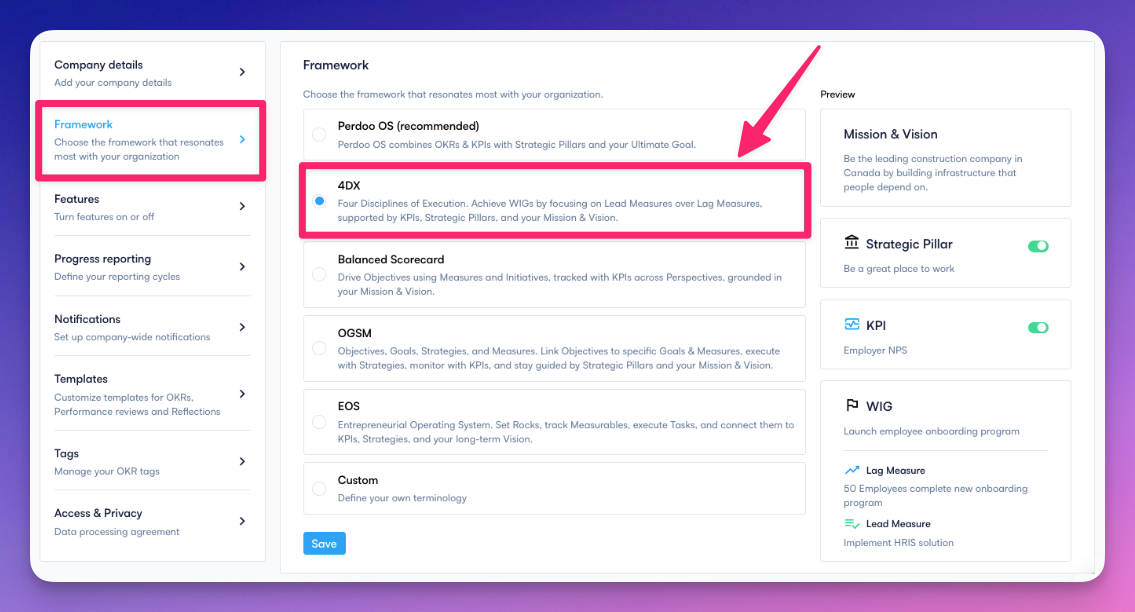
Use Perdoo for 4DX
Perdoo is framework-agnostic! So, yes, you can also use Perdoo for 4DX.
Just follow these simple steps:
- Create a free Perdoo account.
- Go to Configure > Frameworks.
- Select 4DX.
Conclusion
The 4 Disciplines of Execution is a proven framework for turning strategy into reality. By focusing on key goals, tracking progress, and maintaining accountability, organizations can drive meaningful results. However, success requires commitment, discipline, and the right leadership support. Whether used alone or alongside OKRs, 4DX can be a game-changer for execution.

Ready to get started?
Free for up to 5 people.