
Watch a quick walkthrough or book a demo
Request successful.
Our team will contact you within one business day.
Pick a time that works for you and we'll send the invite.
Oops! Something went wrong while submitting the form.
Sign-up successful!
Check your inbox for a link to activate your free Perdoo account.
All resources
Blog

Strategy & Goals
End-to-end strategy execution: What it is and why your company needs it

Henrik van der Pol
13
min
read
Key Takeaway: Most strategies don't fail at the offsite. They fail in the gaps between strategy, KPIs, OKRs, projects, meetings, and Performance Reviews, because each lives in a different tool, with a different owner and a different rhythm. End-to-end strategy execution closes those gaps: One connected system where every task traces back to a project, every project to an OKR or KPI, and every goal to your strategy, with meetings and reviews running on the same live data. Start this week by tracing three random tasks back to your strategy. Wherever the trail goes cold is where your execution leaks.
Picture your last quarterly business review. The Finance team presents numbers from one dashboard. Marketing brings a slide deck with its own version of the pipeline. Product shares a roadmap from its project tool. Then someone asks how all of this connects to the three strategic priorities you agreed on in January, and the room goes quiet.
Nobody's doing a bad job. Everyone's busy. And that's exactly the problem: Everyone's busy with something, but nobody can say with confidence whether all that activity is moving the company where it needs to go. And with AI agents making it easier than ever to start new work, that pile of activity is only growing.
You're in good company if this sounds familiar. Research published in Harvard Business Review found that two-thirds to three-quarters of large organizations struggle with execution. I've had this conversation with hundreds of leadership teams over the past 10 years, and while the details differ, the pattern is always the same. The strategy is fine. The people are capable. What's missing is the connection between all the pieces.
That's what end-to-end strategy execution is about.
What end-to-end strategy execution means
Strategy execution is the discipline of turning a strategy into results. End-to-end strategy execution means running it as one connected system, instead of a collection of disconnected processes.
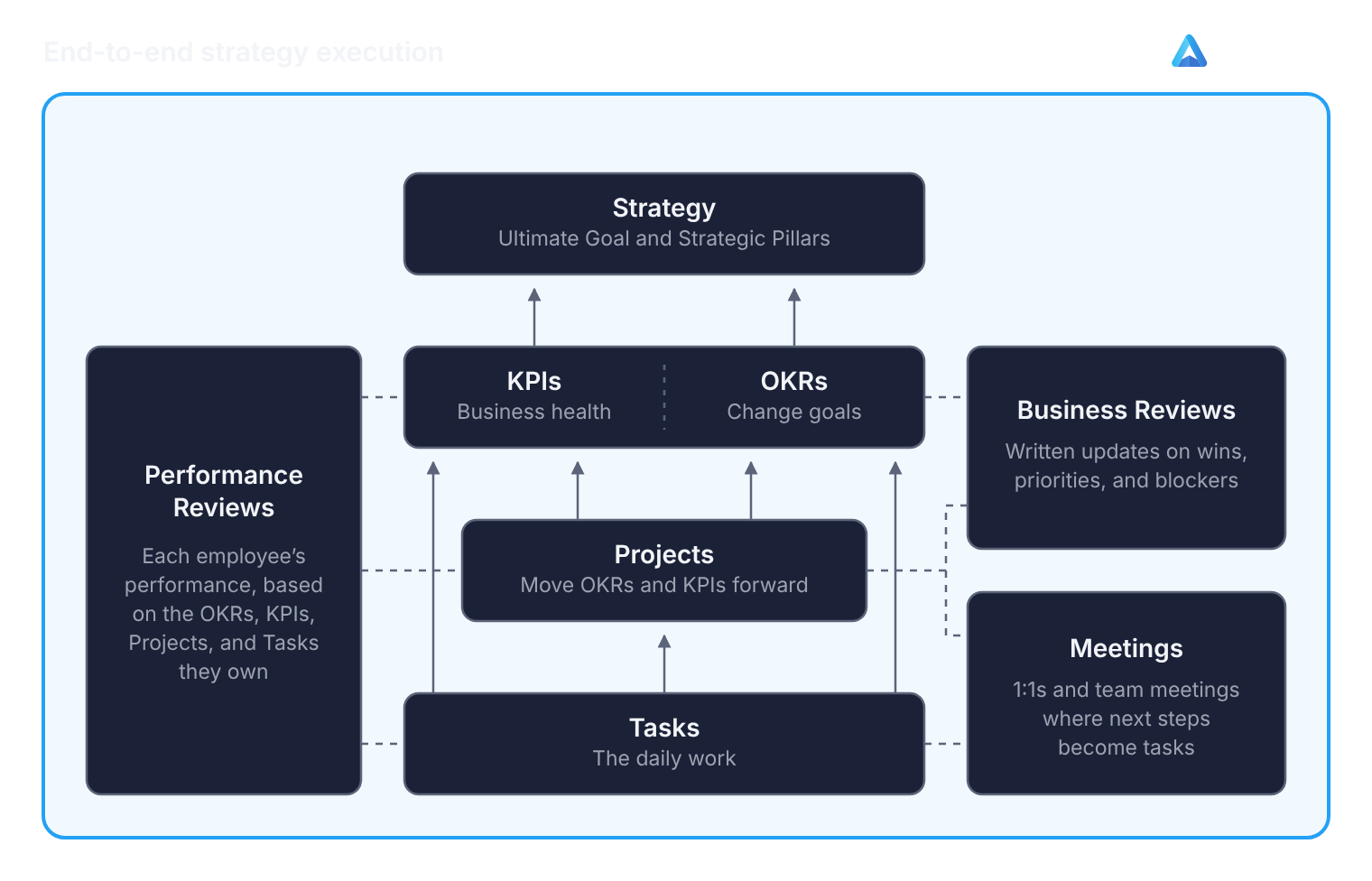
In practice, it covers seven layers:
- Strategy: Where you're going, and the choices you've made about how to win.
- KPIs: Business as usual; the metrics that tell you whether the business is healthy.
- OKRs: The changes you're driving this quarter or year.
- Projects and tasks: The work that moves those goals forward.
- Business Reviews: Regular (written) updates on wins, priorities, and blockers.
- Meetings: Where teams and managers act on progress and agree on next steps.
- Performance Reviews: Where individual contribution connects back to company results.
Most organizations already have all seven. The problem is that they're managed separately. Strategy lives in a slide deck from the last offsite. KPIs live in a BI tool that most people can't even open, because licenses are expensive, the data is confidential, or both. OKRs live in a spreadsheet, if they exist at all. Projects and tasks are scattered across a whole range of productivity tools, each living in its own silo. Meeting notes live in docs nobody opens twice. And Performance Reviews live in an HR system that has no idea what anyone actually worked on.
"End-to-end" means the thread runs unbroken from top to bottom, and back up again. A CEO can start at the Ultimate Goal and drill down to the task someone's working on today. An engineer can start at their task and see exactly which strategic choice it serves. Wherever that thread breaks, you lose sight of what's really happening.
That doesn't mean you have to rip out every tool your teams rely on. End-to-end isn't about doing everything in one place. It's about making sure everything connects. Your Engineering team can keep working in Jira or Linear, and your Sales team can keep living in Salesforce. What matters is that the work in those tools links back to the goals it's supposed to move. In Perdoo, that's exactly what our integrations are for. The result is one central overview: A single source of truth for everything that's happening across the company.
The symptoms most leadership teams recognize
Few executives would say "we lack end-to-end strategy execution." They describe the symptoms instead. These are the ones you'll hear most often.
Everything is a priority
Every team has 15 things going on. New projects get added, but old ones rarely get stopped. When I ask a leadership team to list the company's priorities, I often get a different list from each person in the room.
It gets worse further down the organization. The same Harvard Business Review research found that only half of middle managers can name any of their company's top five priorities. If your managers don't know the priorities, their teams certainly don't.
Nobody has the full picture
Ask a simple question like "Are we on track for this year?" and watch what happens. Someone pulls numbers from three systems, merges them in a spreadsheet, and sends you a deck a week later. By then, it's out of date. Leaders end up steering by anecdote, gut feel, or whoever spoke last.
Accountability is fuzzy
Goals are "owned" by departments, or by the leadership team collectively, which means nobody really owns them. When something slips, it's unclear who should have raised the flag, and even less clear who should fix it.
Work happens, but you can't tell if it matters
Teams ship features, run campaigns, and close tickets. Status reports are green. But busy doesn't mean effective. Without a link between the work and the outcomes it's supposed to drive, you can't tell progress from motion. It's an expensive blind spot: Bain reports that executives say they lose 40% of their strategy's potential value to breakdowns in execution.
Meetings are where updates go to die
Most management meetings are status recitals. People read out what they did, nobody makes a decision, and the same issues come back two weeks later. Whatever does get decided ends up in meeting notes that nobody opens twice. Meanwhile, the volume of coordination keeps growing. Microsoft's Work Trend Index found that employees are interrupted every two minutes during core work hours, 275 times a day, by meetings, emails, or chats.
Performance Reviews feel disconnected from reality
Once or twice a year, managers try to remember what each person contributed. Because goals and work live elsewhere, reviews turn into a memory test. It's no surprise that, according to Gallup, only 14% of employees strongly agree their Performance Reviews inspire them to improve.
If you recognized three or more of these, you're not alone. In my experience, it's the norm, not the exception. And it's not a sign that your people are falling short. It's what happens when seven interdependent processes are run in seven different places.
Why disconnected systems create chaos
Each layer depends on the one above it for direction, and on the one below it for results. KPIs tell you where the business needs attention, which should shape your OKRs. OKRs tell teams what to change, which should decide which projects and tasks get resources. Projects and tasks are the work that shows up in meetings and, eventually, in Performance Reviews.
The review rhythm depends on all of this too. Business Reviews only add useful context when they sit next to the numbers they explain. Meetings only lead to decisions when everyone's looking at the same, up-to-date picture of strategy, goals and work. And Performance Reviews are only fair when they're based on what people actually contributed to those goals, not on what a manager happens to remember.
When those layers live in different tools, every connection becomes a manual job. Someone has to translate strategy into goals, goals into projects, and project status back into progress reports. Then someone has to chase updates before every meeting, and reconstruct months of work before every Performance Review. That translation work is slow, error-prone, and usually the first thing to slip when people get busy. A few weeks into a new quarter, the connections are gone and every layer starts drifting on its own.
That's how you end up with 40 active projects, 12 "strategic priorities," and a leadership team that's working harder than ever while feeling less in control.
AI agents are speeding up the chaos
AI is making all of this worse. Every employee now has assistants and agents that can draft a campaign, build a prototype, or spin up a new analysis in minutes. That's great for productivity, but it also means people pick up more work than ever, and almost nobody checks whether that work pushes the company in the right direction. When starting something new takes an afternoon instead of a month, side projects multiply. In my experience, few leadership teams can even see how much of this work exists, let alone what it's for. Without a clear line from every piece of work to a goal, AI doesn't accelerate your strategy. It accelerates the noise.
I see it in my own work, too. Nowadays, as CEO of Perdoo, I have several agents working in the background, and with each one, it's easy to get pulled down a rabbit hole of work. Because I work with AI so much, I find myself going back to our Perdoo account more often than ever. It's where I'm reminded of what actually matters most right now, and what we agreed to focus on this quarter.
The 7 layers of end-to-end strategy execution
Below, I walk through what each layer looks like when it's done well, and how it connects to the others.
1. Strategy: Decide what winning looks like
Everything starts with clarity at the top. In Perdoo's framework, that means an Ultimate Goal that describes what winning looks like, plus a small set of Strategic Pillars, the strategic choices about how you'll win.
A Strategic Pillar isn't a goal and has no deadline. It's a direction, a choice, like "Be the go-to partner for mid-market manufacturers" or "Win on customer experience."
The key is to make this visible. A strategy that lives in a slide deck can't guide day-to-day decisions. A Strategy Map that shows how every goal connects to your Strategic Pillars can.
2. KPIs: Keep the business healthy
KPIs are maintenance goals: The metrics of business as usual, like revenue, churn, cash runway, customer satisfaction, and uptime. You're monitoring them because you need to know the moment one goes off track.
In an end-to-end system, every KPI has a target, a team that owns it, and a lead who's accountable for it. And it sits right next to your strategy and OKRs instead of being buried in a BI tool. When a KPI turns red, that could be the trigger for a new OKR.
3. OKRs: Drive the changes that matter
Where KPIs keep the business running, OKRs change it. An OKR is a change goal: An inspiring Objective, paired with a few Key Results that measure the outcome you're after. Our OKRs vs KPIs comparison explains how the two work together, and the Ultimate OKR guide covers the basics.
What makes OKRs part of an end-to-end system is alignment. Every OKR should have a parent: A Strategic Pillar, a KPI, or another OKR. Rigid cascading, where, for example, a company's Key Result turns into a team's Objective never works. Instead, focus on directional alignment: Teams aligning their OKRs to company goals — even when these team OKRs are dictated top down.
And don't skip the end of the cycle. Closing your OKRs is where you document what you achieved, what you learned, and what happens next: Does the OKR roll over, turn into a KPI to maintain, or get dropped? Most companies rush past this step to start setting new goals. In my experience, it's one of the most valuable moments in the whole cycle, because those learnings shape better OKRs next quarter and build an institutional memory that doesn't walk out the door when people leave. Here's how to close OKRs properly.
4. Projects and tasks: Connect the work to the goals
This is where most strategies break. Projects are the bodies of work that move an OKR or KPI, and tasks are the individual steps that get them done. When projects and tasks are linked to goals, two things happen. First, you can see whether the work is actually moving the needle. Second, you can spot work that doesn't serve any goal at all. Stopping that work is one of the fastest ways to free up capacity.
This layer is also how individuals connect to the strategy. For organizations new to OKR, I don't recommend giving every individual their own OKRs, but let them contribute through the projects and tasks they own, and that's plenty.
5. Business Reviews: Add the story behind the numbers
Progress percentages tell you where you stand, but not why. That's what Business Reviews are for: Short written updates that add context to your goals and numbers. Each one typically covers recent wins, priorities for the next cycle, and where support is needed.
They work at three levels. Every employee writes a User Review, usually weekly. Team leads summarize their team's cycle in a Team Review, usually monthly. And executives summarize the company's cycle in a Company Review, usually quarterly.
In an end-to-end system, these reviews sit right next to the live progress of your OKRs and KPIs. Leaders no longer chase status updates or compile numbers before a leadership meeting. They read what each team achieved, what's next, and where it's stuck, and spend their time on the decisions that follow.
Where you write these reviews matters. Updates sent by email or tucked into a slide deck are hard to find a month later. Updates that are only presented at an all-hands, with nothing written down, are gone the moment the meeting ends. When Business Reviews live in the platform, right next to the goals they describe, they build up a memory of your company over time:
- Context survives turnover. When someone leaves or changes roles, the reasoning behind their goals and decisions stays behind.
- New people get up to speed faster. A new manager can read a team's last few reviews and understand where things stand in an hour.
- Patterns become visible. The same blocker showing up three cycles in a row is hard to miss when the reviews sit side by side.
- Fewer status meetings. Anyone can catch up on their own time, so meetings can focus on decisions.
- AI gets the context it needs. Spark can draw on that history, which makes its input far more relevant than anything based on numbers alone.
6. Meetings: Turn conversations into action
Business Reviews keep everyone informed. Meetings are where you act on that information: Weekly team meetings, leadership meetings, and 1:1s. The problem with most meetings isn't that they happen. It's that nothing connects them to the goals or the work.
In an end-to-end system, every meeting has a shared agenda that participants add talking points to, and open points carry over to the next meeting, so nothing gets dropped. Each participant's goals and reviews are right there, so a 1:1 starts with what someone is actually working on. And next steps become tasks with an assignee and a due date, linked to the goal they move where applicable, so they don't vanish the moment the meeting ends.
Instead of "What did you do last week?", the conversation becomes "What's off track, and what are we going to do about it?" And at the next meeting, you check whether last meeting's tasks actually got done, so nothing falls through the cracks.
7. Performance Reviews: Close the loop
Performance Reviews are where individual contribution meets company results. When they're disconnected from goals and work, they're based on memory and impressions. When they're connected, managers and employees can look at what someone actually contributed: The projects they drove, the Key Results they influenced, and the check-ins they wrote along the way.
One caution: Don't turn goal attainment into a scoring mechanism. If people know their rating depends on hitting their OKRs, they'll set safe goals, and you lose the ambition that makes OKRs work. Goals should inform the conversation, not decide the outcome. Read more about how to embed goals in Performance Reviews without corrupting them.
What changes when it's all connected
I've seen this shift happen with many customers, and the results are remarkably consistent:
- Focus improves. When every project or task has to link to a goal or strategy, orphan work becomes visible, and leadership teams start cutting.
- Everyone understands the big picture. Anyone in the company can open the Strategy Map and see what matters, who owns what, and how it's going.
- Accountability becomes explicit. Every goal, project, and task has a named owner and lead, and regular progress updates show who's on top of their work.
- Meetings get shorter and better. With live data on the table, you spend time on decisions instead of updates.
- Reporting stops being a project. The numbers are already there, easily exportable to CSV, PDF, or PPT, so your board deck takes half an hour instead of a week.
- Performance Reviews get fairer. Performance conversations are based on real contributions, not on who's most visible.
- Adapting gets faster. When the market shifts, you can see which goals and projects are affected and reprioritize in days, not months.
- The system keeps getting smarter. Every goal, progress update, business review, and closing note adds context, so the insights you get back improve with every cycle.
Why adding more tools won't fix it
The instinctive response to execution problems is to buy another tool: A dashboard tool for KPIs, a separate tool for projects, an HR tool for reviews. Each of them might be great at what it does. But every new tool adds another place where information lives, and another connection someone has to maintain by hand.
The value of end-to-end execution doesn't come from any single layer. It comes from the connections between them. A great project tool can tell you a project is 80% done. It can't tell you whether that project is moving the KPI or Key Result it was meant to move, or whether that goal still matters to your strategy.
This matters even more now that AI is part of how we work. AI is only as useful as the context it has. If your strategy, goals, and work are spread across seven disconnected systems, AI only sees fragments. When they live in one connected system, AI can actually help: Reviewing goals, spotting what's at risk, and flagging work that doesn't connect to anything.
There's a compounding effect, too. When your strategy, goals, reviews, and decisions are all documented in one system, that system learns faster with every cycle. It becomes a self-reinforcing loop: The more context you put in, the better the insights you get back, and the better the insights, the more people use it. I see this with our own customers. The ones who were already tracking their strategy, KPIs, and OKRs in Perdoo, and who were diligent about their business reviews and closing notes, now get far more value out of Spark, our in-app AI Agent. Their history is what makes the AI genuinely useful.
Start by tracing your execution chain
You don't need a big transformation program to find out where your execution leaks. Try this exercise this week:
- [one-col]Pick three random tasks from your teams' boards or to-do lists.
- For each one, trace it upward. Which project is it part of, which OKR or KPI does that project move, and which Strategic Pillar does that goal serve?
- Then go the other way. Take your most important strategic priority and trace it down to the work that's happening on it this week.
- Note every point where the trail goes cold, where you have to ask someone, open another tool, or simply guess.
Every gap you find is a place where strategy leaks out of your organization. If you find more than one, you don't have an execution problem in one team. You have a system problem, and that's exactly what end-to-end strategy execution solves.
Perdoo was built to be that system. It brings your Strategy Map, KPIs, OKRs, projects, and tasks together with check-ins, business reviews, meetings, reports, dashboards, and Performance Reviews, so the thread from strategy to daily work never breaks. And because everything is connected, Spark, our in-app AI Agent, can review your OKRs and KPIs and help you refine your Strategic Pillars with the full picture in view.
Start for free or request a demo to see what end-to-end strategy execution looks like in your organization.

Ready to get started?
Free for up to 5 people.