
Sign-up successful!
Check your inbox for a link to activate your free Perdoo account.
Watch a quick walkthrough or book a demo
Request successful.
Our team will contact you within one business day.
Pick a time that works for you and we'll send the invite.
Oops! Something went wrong while submitting the form.


EOS: Entrepreneurial Operating System - Complete Guide (2026)
15
min
read
What is EOS?
EOS is an organizational management framework that focuses on efficiency and growth. Read on to learn about the EOS framework, the differences between EOS and OKR, how the two frameworks can work together, and how you can seamlessly manage EOS in Perdoo.
New to Perdoo? Create a free ccount to turn a great strategy into amazing results.
[fs-toc-omit]What is EOS?
EOS stands for Entrepreneurial Operating System, developed by Gino Wickman in his book “Traction”. EOS is a comprehensive approach to business management and a versatile process for leadership to ensure alignment throughout any kind of organization. It is, however, best used in small to mid-sized organizations.
The EOS framework consists of 6 main components:
- Vision: The first step required is to establish a clear and compelling vision. This involves defining where the organization is headed and ensuring everyone understands and aligns with this vision.
- People: Ensuring that the right people are in the right seats within the organization is critical. This involves evaluating individuals' skills, values, and performance and ensuring they are aligned with the company's goals.
- Data: Utilizing data to drive decision-making is crucial for organizational success. Data emphasizes the importance of identifying and tracking key metrics to provide insights into the company's performance and health.
- Issues: Addressing and solving issues systematically is vital for overcoming obstacles and maintaining progress. EOS provides a structured approach to identifying, prioritizing, and resolving problems as they arise.
- Processes: Creating and documenting core processes ensures consistency and efficiency in daily operations. Doing so defines the essential steps and procedures to achieve the company's objectives.
- Traction: Traction is about executing the vision through discipline and accountability. This component ensures that everyone within the organization is focused on achieving the company's goals and is held accountable for their contributions.
Organizations implementing EOS typically engage in weekly and quarterly meetings to maintain focus and accountability. The weekly Level 10 meetings, for instance, provide a structured platform for teams to discuss and resolve issues, review key metrics, and track progress toward goals. Quarterly planning sessions, on the other hand, allow organizations to reassess their long-term objectives and make necessary adjustments.
EOS also encourages the use of tools like scorecards, rocks (short-term goals), and accountability charts to ensure alignment and transparency throughout the organization. By consistently applying these tools and principles, companies using EOS experience improved communication, increased accountability, and sustained growth.
How do EOS and OKR compare?
Objectives and Key Results (OKR) is a goal management framework designed to execute strategy and is a powerful way to formulate and communicate goals. While both the EOS and OKR frameworks aim to enhance organizational performance, communication, and efficiency, there are a few distinct differences in their scopes and focuses.
While EOS provides a broader organizational strategy, OKR offers a more targeted approach to goal alignment and measurement that is directly linked to an organization’s overarching strategy. Both frameworks, however, share a commonality in their commitment to fostering clarity, accountability, and alignment within an organization. They both promote regular check-ins, transparency and the use of data for informed decision-making, providing companies with effective tools to navigate the complexities of today's business environment.
The 3 main differences between EOS and OKR:
- Operating system vs framework
EOS is considered an operating system that accounts for a business as a whole. They have a defined way of managing the system through Weekly L10 meetings to maintain alignment, and they encourage the use of “Implementers” — trained EOS consultants — to oversee the processes. These tools ensure clear direction for people and all the required components of EOS.
OKR on the other hand is an independent goal management and setting framework. While it doesn’t have a defined toolset like EOS, it encourages starting with the strategy to ensure alignment throughout the organization, thus promoting efficiency. Additionally, frequent meetings and the use of Check-ins to ensure transparency and that teams are moving in the right direction.
- Time frames
Time frames used in both EOS and OKR differ. With EOS the time frame used is longer than with OKRs. It’s encouraged to set a 10-year target, and every business process is managed and evaluated in quarterly and annual sessions (Traction).
OKR works with a more flexible time frame. While quarterly and annual time frames are recommended, you’re able to set any time frame that works best for your organization and teams.
- Who uses the frameworks?
EOS and OKR can be applied within any industry, however, EOS mainly focuses on business leaders and their overarching business model. On the other hand, OKRs are more universal in nature. While OKR can be exclusively used at the executive level, it can also be across all business functions (any or all departments, teams, etc.). Larger organizations typically begin by implementing OKR within a specific department before carrying out a company-wide rollout. In contrast, smaller organizations may prefer a company-wide rollout from the start.
How EOS works in Perdoo
Perdoo is framework-agnostic! So, yes, you can also use Perdoo for 4DX.
Just follow these simple steps:
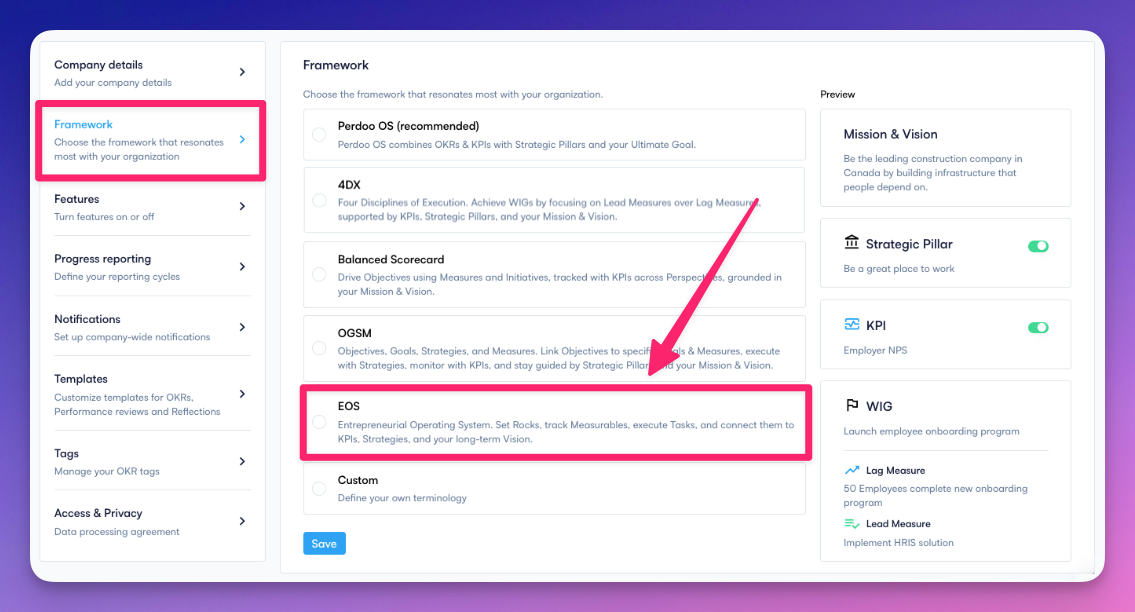
- Create a free Perdoo account.
- Go to Configure > Frameworks.
- Select EOS.
- People → Teams & Users
Without the right people, executing strategy and managing EOS processes successfully is difficult. In Perdoo, you can add all the people you need as users. Teams let you not only group your people as you please, but also help you organize your goals. You can create sub-teams as well.

- Data → Goals, integrations, and reporting
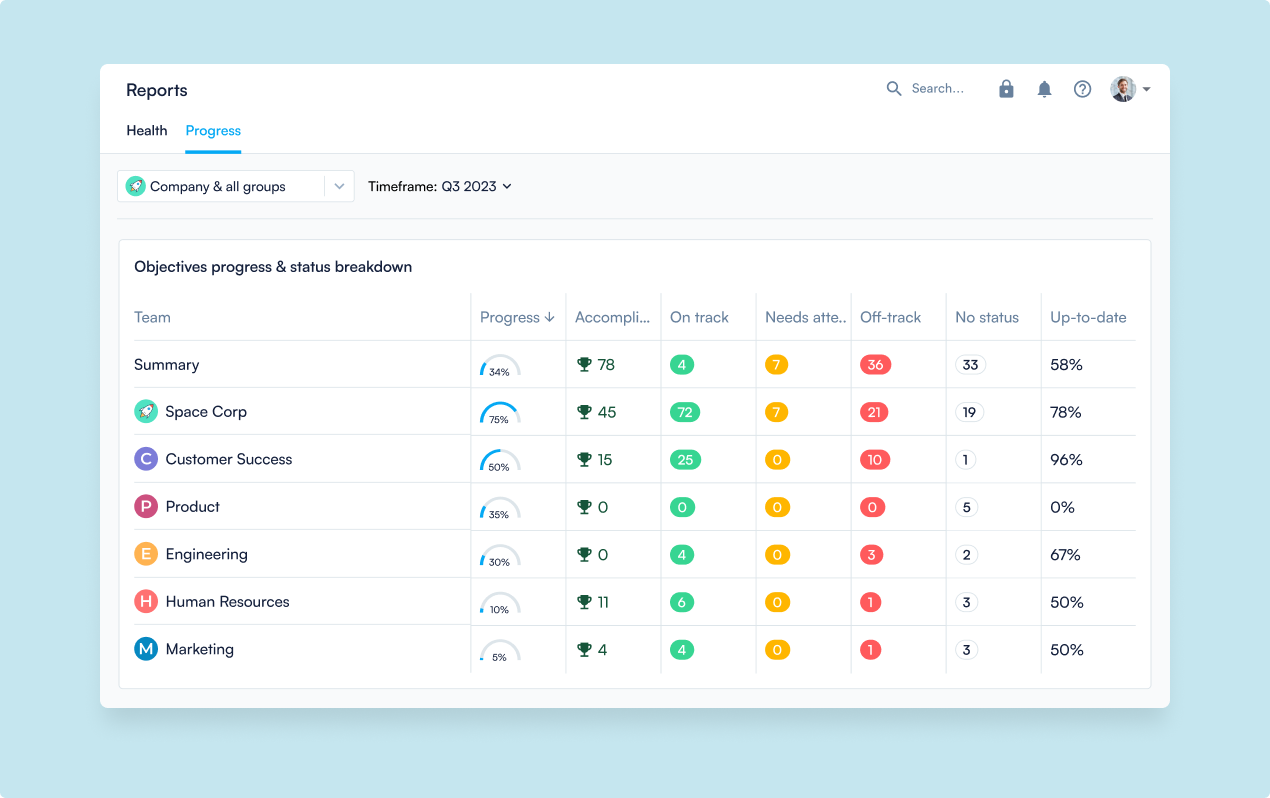
Goals, regardless of whether long or short-term, are driven by data. Key Results and KPIs are based purely on numbers and rely on regular progress updates to ensure that teams are headed in the right direction and that key targets are met. With the help of integrations, you’re able to connect all the tools you work with to automatically push accurate data to the respective goals. To provide an overarching view of how the organization and individual teams are performing, the Progress Report provides a holistic overview of how your entire organization is performing across different timeframes and levels. It helps you stay on top of all goals across your organization by seeing which teams are on track, or spot any issues early on so you can help remove any roadblocks where needed.
- Processes & Issues → Check-ins & 1:1s
All goals in Perdoo are designed to ensure everyone in the organization receives the relevant context needed. This means the goal modals include a description section where you can include the why behind the goal and include any data sources required, as well as an activity feed to keep a historical record of all updates over time.
To create a habit of updating goals, and to provide your team and people with updates on how the goal is progressing, regular Check-ins are encouraged. 1:1 meetings on the other hand are a great way to have consistent meetings with your people to discuss any goal-related or performance matters in a timely fashion to make sure the right steps are being taken. As mentioned above, Progress Reports are a great way to get insight into how the entire organization’s goals are progressing, enabling enough visibility to catch any potential roadblocks in the future.

- Traction → The Perdoo platform
Perdoo is built in a way to provide organization-wide transparency and create accountability around all the work that matters most to an organization and its overarching mission. Strategy Map is the single source of truth that brings your entire organization’s strategy, goals, and people into one place. From here you get visibility into the efforts being made across the company and have the intel to recalibrate efforts if they no longer are serving the higher vision.

Ready to get started?
Free for up to 5 people.