
Sign-up successful!
Check your inbox for a link to activate your free Perdoo account.
Watch a quick walkthrough or book a demo
Request successful.
Our team will contact you within one business day.
Pick a time that works for you and we'll send the invite.
Oops! Something went wrong while submitting the form.
All resources
Guide

Strategy & Goals

Productivity

HR
Getting Started with Perdoo: A Step-by-Step Setup Guide (2026)

Getting Started with Perdoo: A Step-by-Step Setup Guide (2026)
10
min
read
With more than 2000 customers across 70+ countries, Perdoo is the uncontested market leader for OKR & Strategy Execution software.
With Perdoo, you can expect to see impressive results already in the first few months.
"We just wrapped up the first quarter with Perdoo. I've seen an amazing increase in the speed with which large projects are moving forward." — Gerard Danos, CEO at Dixie Iron Works (300ppl, USA)
In this guide, we’ll show you how to quickly get up and running with our software. We'll explain what a good strategy looks like, what the differences are between KPIs and OKRs, and we’ll dive into the processes that will help you — and everyone else in your organization — turn goals into results.
Let's get started.
Why Perdoo?
First things first.
If you're still wondering whether you need a software like Perdoo, this chapter is for you. Everyone else can skip it.
Do you need a software like Perdoo?
That's a simple question. And simple questions require simple answers.
You can't fly an airplane without a cockpit. You can't drive a car without a cockpit. The cockpit ensures a smoothly running engine and helps you navigate to your destination.
Businesses also need a cockpit. That cockpit is Perdoo — a central place for your mission, vision, strategy, and goals. And it comes with all the tools to drive progress and operate at peak performance.
"We had our annual audit yesterday and received a good working practice for using Perdoo. The auditor was very impressed!" — Tom Devine, Managing Director at TMS protection
A more complex answer would be:
- 95% of employees don't know or understand their company's strategy - Harvard Business Review.
- 50% of employees do not know what is expected of them at work - Gallup study.
- CEOs' biggest weakness is holding people accountable - CEO Benchmarking report.
- No surprise that 9 out of 10 companies fail to execute their strategy - Kaplan & Norton.
Here are 3 key improvements that you'll see after your first few weeks with Perdoo:
- Alignment: Everyone will know and understand your organization's strategy.
- Clarity: Everyone will know what they and their team are responsible for.
- Accountability: A simple but effective reporting process will drive progress for your most important goals.
Suddenly, your strategy will come to life. And everything will start moving much faster at your company.
Is Perdoo the right solution for my company?
Choosing the right product can be hard. You might be wondering, out of all the available options, is Perdoo the right choice for my business?
"Perdoo is very well designed. It's largely intuitive to get to grips with, much more so than others. There is a fantastic ecosystem of support resources available, and there's the option of expert coaching." — Robin M., CEO at a mid-market company - G2
While some tools may look similar at the surface, here's what you need to know:
- Perdoo is the only one to cover the entire strategy execution operation. Every other tool misses one, or more, crucial steps of the process.
- Perdoo offers the best balance between ease of use and flexibility. Too much flexibility = complexity = poor adoption. Perdoo has the highest adoption rates in the industry.
- Perdoo's customers benefit from a decade of experience and an evidence-based approach. Our built-in processes have proven to work. And soon-to-be-launched Perdoo AI will be better than anyone else's.
- Perdoo is framework-agnostic. If you ever want to switch from OKR to another framework, no worries, you can keep using Perdoo. We support all major frameworks.
- We provide the best resources & support. More on that later.
But don't take our word for it.
Here are 460 verified reviews from our customers.
Strategy vs KPIs vs OKRs
Let's talk about something that many organizations get wrong: the difference between Strategy, KPIs, and OKRs. And let's use an analogy to keep it simple.
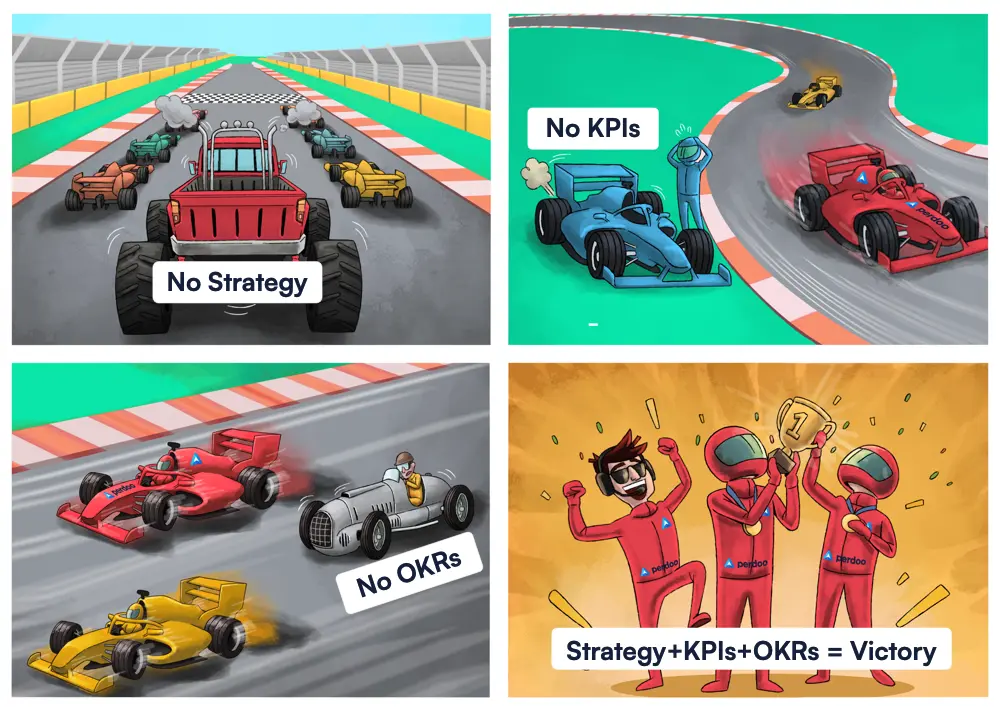
Imagine your organization as a car. Your aim is to win the Dakar rally and cross that finish line before anyone else. That finish line resembles your organization’s ultimate goal (the mission & vision). How do you ensure you reach that desired destination efficiently and, of course, safely? Well, it all comes down to these three high-octane components: Strategy, OKRs, and KPIs.

Strategy: Your how-to-win choices
To prepare for the rally, you need to determine what features your car needs. A Formula 1 race car won’t get you very far in the Dakar Rally. You’ll have to understand the race track, your competitors, etc. That information will influence what type of car you need. These critical decisions are your Strategic Pillars.
Similarly, in business, it’s about knowing your competitors, understanding your target customers, and sizing up your market. Every organization is unique, with its own priorities, circumstances, and resources, and that’s the foundation upon which you’ll build your winning strategy.
OKRs: your roadmap
Your OKRs are your roadmap toward that victory line. As you race forward, the terrain may change, obstacles may appear, and conditions might shift. Some you can plan for, others you’ll adapt to on the fly. That’s why your OKRs, just like rally waypoints, change as you progress toward your ultimate goal.
KPIs: your dashboard
But here’s the thing – as you’re hurtling toward your destination, you can’t just focus on the road ahead. You need to keep an eye on your car’s dashboard to make sure the engine doesn’t overheat and that you don’t run out of fuel as you speed toward the finish line.
The indicators on your car’s dashboard are the things you always need to watch regardless of where you are on your journey. These are your KPIs, simple indicators that monitor your business as usual (i.e. everything you do to keep "the engine" running smoothly).
Your organization’s journey
In businesses, your strategy, OKRs, and KPIs, along with your people (your pit crew) keep your organization at peak performance. But it’s not enough to have one without the others. Just like a skilled driver needs a well-suited car, a reliable roadmap, and real-time feedback, your organization needs Strategy, OKRs, and KPIs working together in perfect harmony.
So, fire up those engines, set your sights on the finish line, and let the powerhouse trio of Strategy, OKRs, and KPIs propel you toward your destination faster than ever before.
Armed with the right tools like Perdoo, you'll become the champion of your own Dakar rally, achieving success that sets you apart from the competition.
Strategy + KPIs + OKRs = Victory
The process
[fs-toc-omit]The strategy execution process
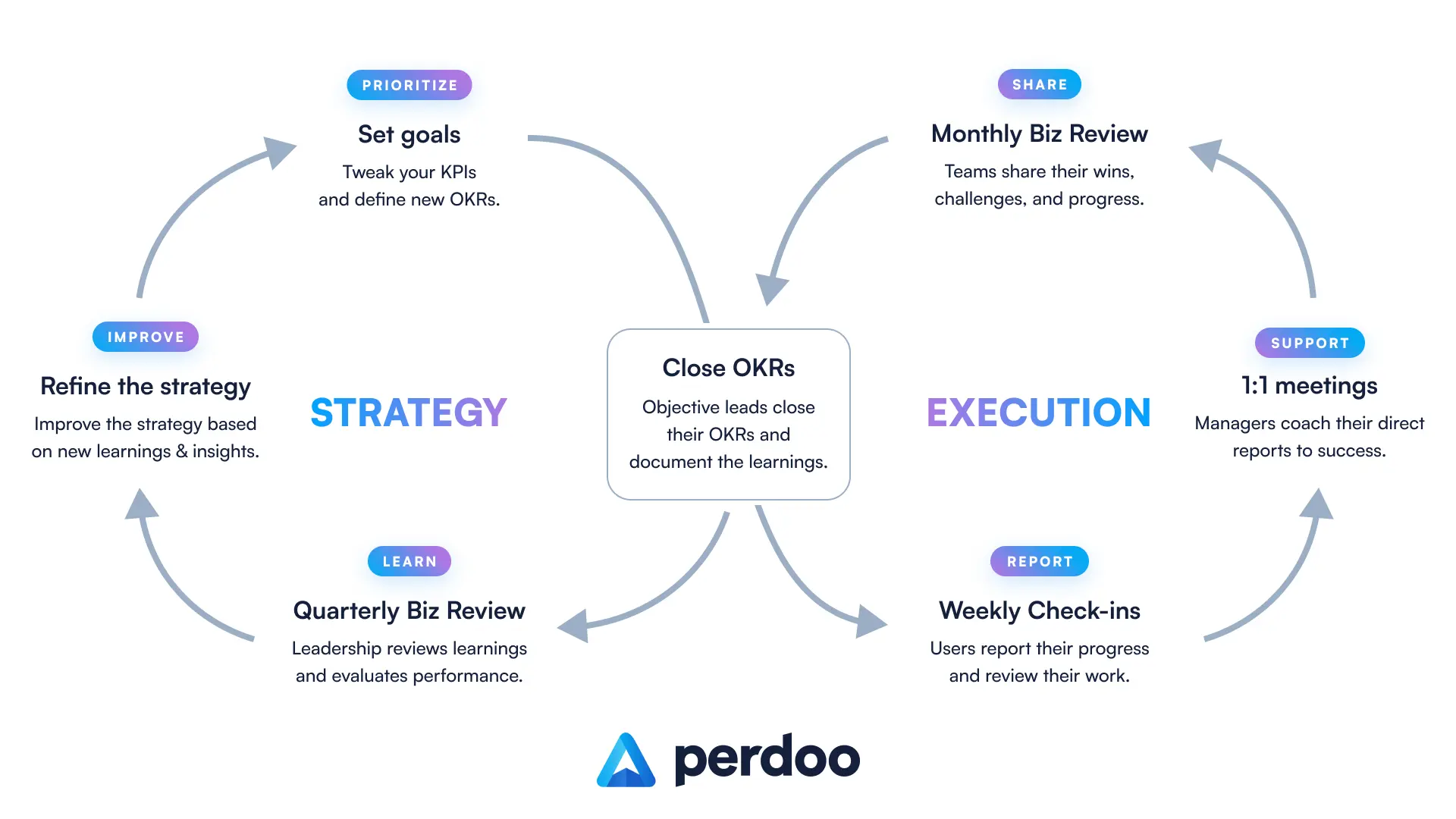
It's important to establish a clear strategy execution process for your company.
In the video below, I explain how the process works at Perdoo.
#1 - Build your Strategy Map
The purpose of strategy is to help you build a strong and defensible market position. In this section, I’ll explain what strategy really is and how to set up your strategy on Perdoo.
Strategy is a military term and comes from the Greek words “stratos” (army or resources) and “ago” (leading). In a military context, strategy thus means to lead your resources to win the battle. A proper business definition would be: to employ your resources to achieve your organization’s (ultimate) goal.
Strategy matters because each organization has finite resources and faces competition. Were resources infinite, you wouldn’t need a strategy — your company could simply do everything it wanted to. And without competitors, there wouldn’t be a need to differentiate yourself. But with limited resources and the constant threat of competition, strategy becomes critical, and (tough) choices will have to be made.
But before those choices can be made, you first need to decide which battle(s) you want to fight and what winning looks like. In other words, you have to decide what your organization’s Ultimate Goal is.
Set your Ultimate Goal
Your Ultimate Goal defines the ultimate winning aspirations for your business.
Which battles will you fight, and which will you leave alone? When will you consider the battle won?
A good Ultimate Goal answers 3 questions:
- What’s the purpose (or mission) of your organization? This is also called your organization’s mission. It explains why your organization was created in the first place, and which problem it is solving.
- For whom is your organization fulfilling that purpose? The problem your organization is solving potentially applies to many people and/or organizations. You can’t serve them all. Pick the (customer) segments that are most important to you.
- When will you consider your venture a success? This is often called your organization’s vision. It says a lot about what you want your organization to become, and explains when you will have won “the battle”.
Example: Perdoo's Ultimate Goal
At Perdoo, our Ultimate Goal is to enable organizations to turn great strategies into amazing results — and be the leading strategy execution software.
Let’s break this down:
- Our purpose is to help organizations successfully execute strategy.
- We’re doing that for small and mid-market businesses across the world.
- And, we want to be the leading strategy execution software while doing this. That’s what winning looks like for us.
Our answers to the 3 questions explain to everyone in our team what our playing field looks like and what it takes to win. This brings an enormous amount of clarity to the team about the direction of the company.
Other examples
- Help SaaS businesses know their customers.
- Be the market leader in Behavioural Analytics.
- Be the leading construction company in Canada by building infrastructure that people depend on.
Scroll down for a video on how to add your Ultimate Goal to Perdoo.
Define your Strategic Pillars
Now that we know where we’re playing and what winning looks like, it’s time to figure out how to win. Our how-to-win choices explain how we aim to overcome key challenges and how we aim to differentiate ourselves in the market.
These choices are directly connected to your Ultimate Goal: they explain how to win on the chosen playing field. Change your Ultimate Goal, and you’ll have to revisit how to win on that new playing field. Your Ultimate Goal and Strategic Pillars are, therefore, jointly called your “strategy”.
The purpose of strategy is to build a strong market position. A strong market position differentiates your business from the competition and is defensible. If your ambition is to become a market leader, you’ll also want to remain market leader once you get there.
Your how-to-win choices will be the pillars that will support your Ultimate Goal — that’s why we call them Strategic Pillars. You should aim to have 3 to 5 Strategic Pillars.
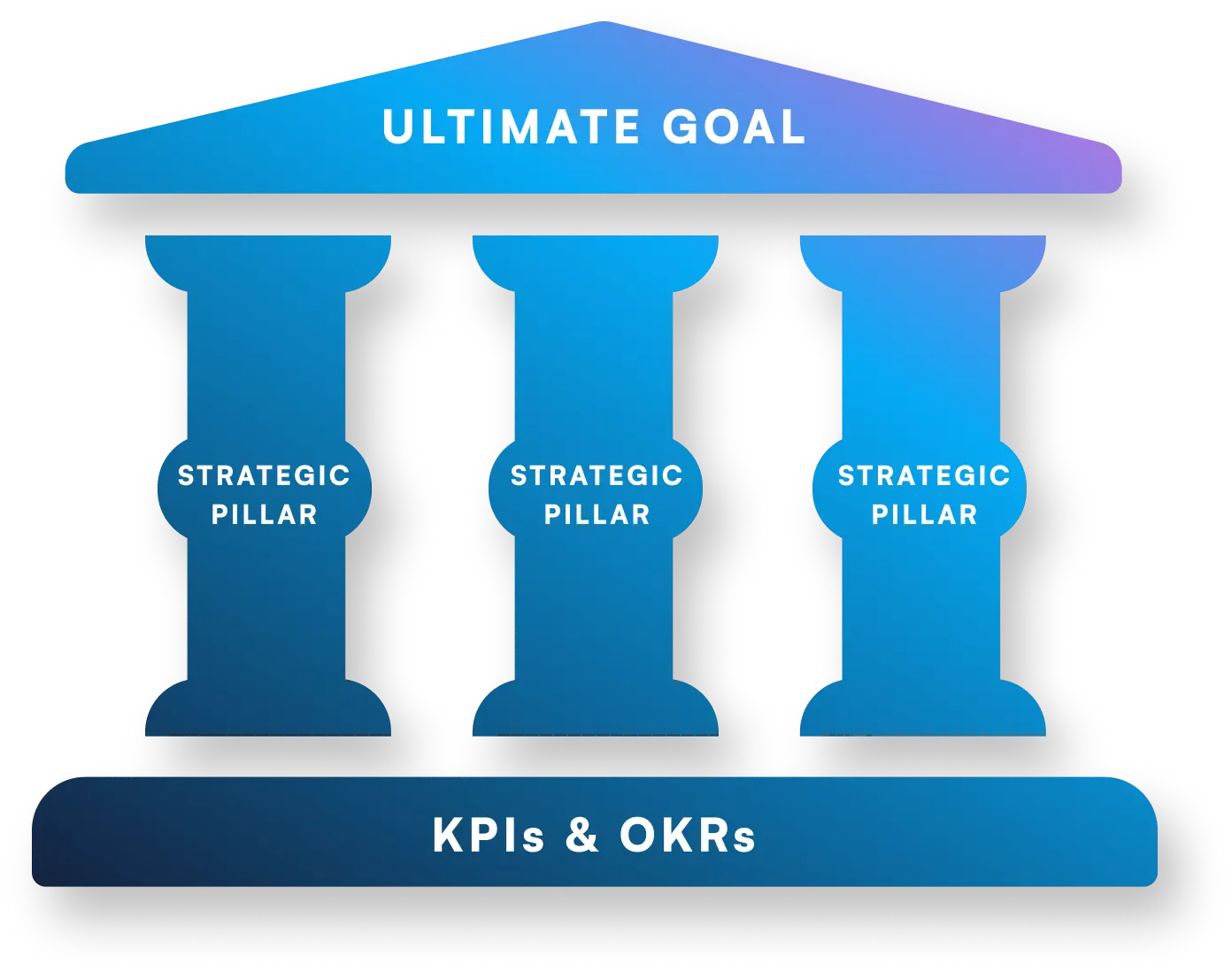
Example: Perdoo's Strategic Pillars
- Be a great place to work
We're in the tech industry. Talent is scarce, so we need to build a work environment that is able to attract and retain the talent that we need to build a successful business. - Offer the best resources & support
In our industry, it takes more than just software to make our customers successful. We support our customers with excellent resources, super-fast in-app support, and industry-leading coaching. And we do this better than any competitor. - Build a tool that everyone can use
Old-fashioned strategy tools are needlessly complex and so expensive that they’re only being used by leadership teams — but strategy execution involves everyone within an organization. So we need to build software that everyone in a company can use. And that’s affordable so that everyone can get access. - Market leader through sustainable growth
Perdoo is a self-funded business and we’d like to keep it that way. We grow organically and sustainably.
You can take a look at our Strategy Map here.
How to build your Strategy Map on Perdoo
#2 - Set goals
When setting goals, I'd always recommend to get your KPIs in place first. KPIs monitor your business as usual, everything you do to keep the lights on. KPIs will help you define later on what your OKRs should be.
KPIs
KPI stands for Key Performance Indicator. KPIs help you monitor your business as usual and maintain the status quo.
While setting your KPIs, you are defining what the key areas of your business are, and you are using a metric (as well as a target value) to indicate how that key area is performing.
The anatomy of a KPI
A KPI consists of the following elements:
- Metric
- Target type
- Current value
- Target or Threshold value
Metric
The Oxford Dictionary defines a metric as “a system or standard of measurement.” Specifically for businesses, they use the following definition: “a set of figures or statistics that measure results.”
As you can see, the word measure is encapsulated in the term metric. Historically, that makes sense, since the word metric is originally derived from the Greek word métron (μέτρον), which means “measure” or “something used to measure.”
In other words: a metric is a tool to measure something.
Example metrics
Let’s say you want to measure the success of your product. There are different metrics you could look at to measure this, such as:
- Customer Renewal Rate (or Customer Churn Rate)
- Monthly Active Users
- Net Promoter Score
If you want to measure the financial performance of your organization, you could use metrics such as:
- EBIT
- Cashflow
- Burn rate
Target type
[Coming soon]
Current value
A metric will always have a current value, which is simply the value that your metric has at any point in time.
For some metrics, the way the current value is calculated may differ from one organization to the next. For example:
- When calculating the current value for Customer Renewal Rate, you can use:
- Customers that renewed this month / Customers that were up for renewal this month.
- Customers that renewed this month / Total number of customers.
- Customers that renewed this quarter / Total number of customers.
- Or, when calculating the growth of your website traffic, you can use:
- Unique visitors this month / Unique visitors last month.
- Unique visitors this month / Unique visitors in the same month last year.
- Sessions this quarter / Sessions previous quarter.
Target or Threshold value
The target value is the minimum or maximum value that you want that metric to have. This target value tells you what good performance looks like. Without such a target value, the KPI can’t be an indicator of performance because you don’t have an idea yet of what good performance looks like. This is really important: a KPI isn’t a real KPI without a target value.
Whatever you consider to be “good performance” is of course subjective. However, sometimes there are industry benchmarks available — that would remove such subjectivity. For example, for a B2B / software-as-a-service website that offers an instant signup option on its website (like perdoo.com does), a healthy visitor-to-lead conversion rate is around 7% or higher.
OKRs
OKR stands for Objectives and Key Results. OKRs help you break out of the status quo and get you closer to your Ultimate Goal.An OKR consists of an Objective, which tells you where to go, and several Key Results, which are the results you need to achieve to get to your Objective. Initiatives are all the projects and tasks that will help you achieve your Key Results.
[okr-guide-inline-pointers]
Examples

OBJECTIVE
Crush the competition through acquisitions
KEY RESULTS
- Acquire 3 small players in our industry
- Secure budget approval from shareholders
OBJECTIVE
Be a top place to work in the U.S.
KEY RESULTS
- Reach top 10 in Fortune 100 best places to work
- Hire a People & Culture Manager
OBJECTIVE
Optimize the sales funnel to close more deals in less time
KEY RESULTS
- Increase opportunity win rate from 12% to 20%
- Launch a new discounting model
OBJECTIVE
Create a more goal-oriented culture
KEY RESULTS
- 100% of employees are contributing to an OKR
- Invite all employees to Perdoo
OBJECTIVE
Empower our support team to be more self- sufficient
KEY RESULTS
- Reduce ticket escalation by 15%
- Create Q&A document for top 20 escalated issues
How often should you set OKRs?
OKRs are usually created on 2 cadences: annual and quarterly.
Company OKRs are typically set annually whereas individuals and teams set OKRs quarterly. Company OKRs are purely directional and therefore a longer time span makes sense. Team OKRs are tactical and therefore quarterly makes more sense: the corresponding shorter review cycles enable organizations to change direction if tactics are not driving progress towards the Company OKRs for the year.
By default, Perdoo has created the annual and quarterly cadences for you. You can change this here. However, when new to OKR, I strongly recommend starting with annual and quarterly.
Who should set the OKRs?
The Company OKRs should be set by the senior leadership team.
The Team OKRs should be set by the respective VPs, Heads of, and Team leads.
Team OKRs can also be dictated top-down and set by the leadership team. I recommend, however, letting the managers come up with a first proposal themselves, which can then be reviewed by the senior leadership team to ensure everyone is on the same page.
Who should lead the goals?
The senior leadership team should lead the annual company OKRs.
For now, it would be best to let the Heads of and Team leads lead the goals of their respective teams. At a later stage, it will be better to distribute accountability across the team.
#3 - Turn goals into results
Goals are your anchor in the storm. But each day is full of distractions, so you’ll have to be reminded of them at least once a week. And you should regularly report on their progress.
For this, we have a Check-in feature. Check-ins are the ideal way for employees to share their wins, challenges, and progress with their managers and co-workers.
Regular Check-ins help your people achieve more goals, improve 1:1s with their managers, and remove recency bias from their performance reviews. And all it takes is 5 minutes per week.
Your people can check in via the web app, mobile app, or through our Slack or Microsoft Teams integrations.
How to configure progress reporting
Go to Configure > General > Progress reporting to customize how you want to report on progress at User- as well as Team-level.
- Frequency
- Choose from Weekly, Every two weeks, or Monthly.
- We recommend Weekly.
- Update reminders
- Make sure no one forgets to submit their Check-in! Choose when people should receive a reminder to report their progress.
- We recommend Fridays, so at the end of the workweek.
- User / Team Review
- Pulse
- Progress report emails
Progress reports for Direct reports
Perdoo also sends me a weekly overview of my direct reports' progress.
I review their report. If all goes well, I leave a comment letting them know that I’ve reviewed it and that I think they’re doing well. If anything requires further discussion, I'll add it as a Talking Point to our 1:1 meeting.
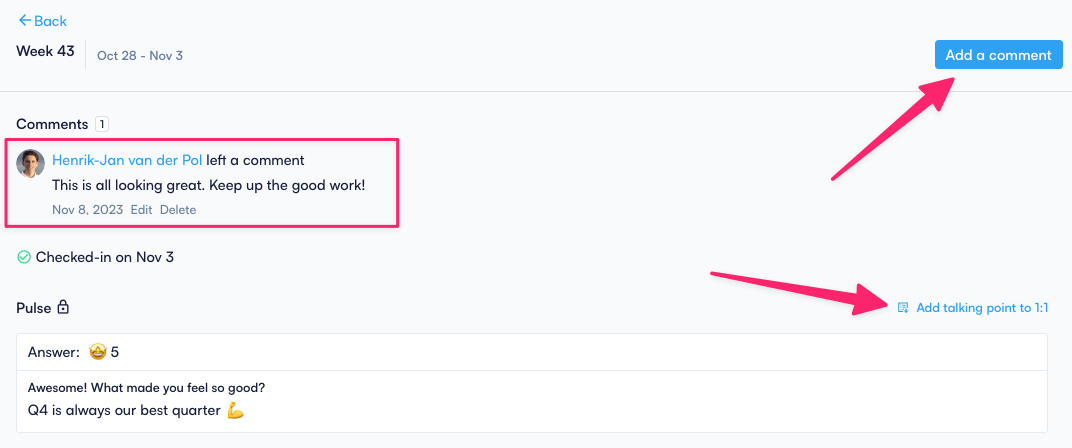
All this info is also neatly surfaced during Performance Reviews, making it a lot easier for me to avoid recency bias and provide constructive feedback.
Progress reports for Teams
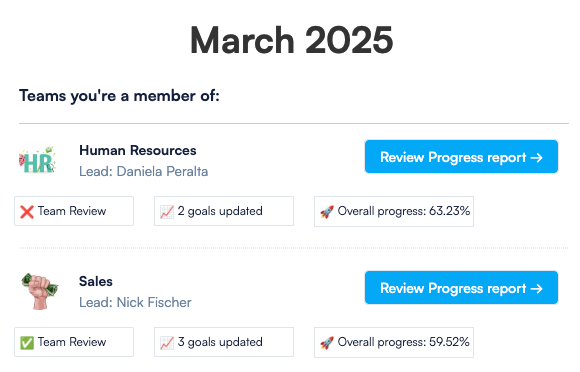
Every month, Perdoo emails me an overview of my teams and how they progress. From here, I can easily click through to the full Progress report in Perdoo.
Here's what such a report looks like.
I read the Team Review, check their progress, and reply to updates that require more info.
KPI Boards
Another way to stay on top of performance are KPI Boards. In the following video I explain what these are how they work.
How does Perdoo fit into my company’s toolset?
Your company started with an ambition, as well as a strategy to help you acquire a strong position in your desired market. Perdoo enables you to set and communicate the direction, track all the goals that will help you get there, and manage all the work that drives progress on these goals. As you see, Perdoo will be a critical tool to help you realize your strategy and ambitions. And it works together with the other tools that you need to build a successful business.
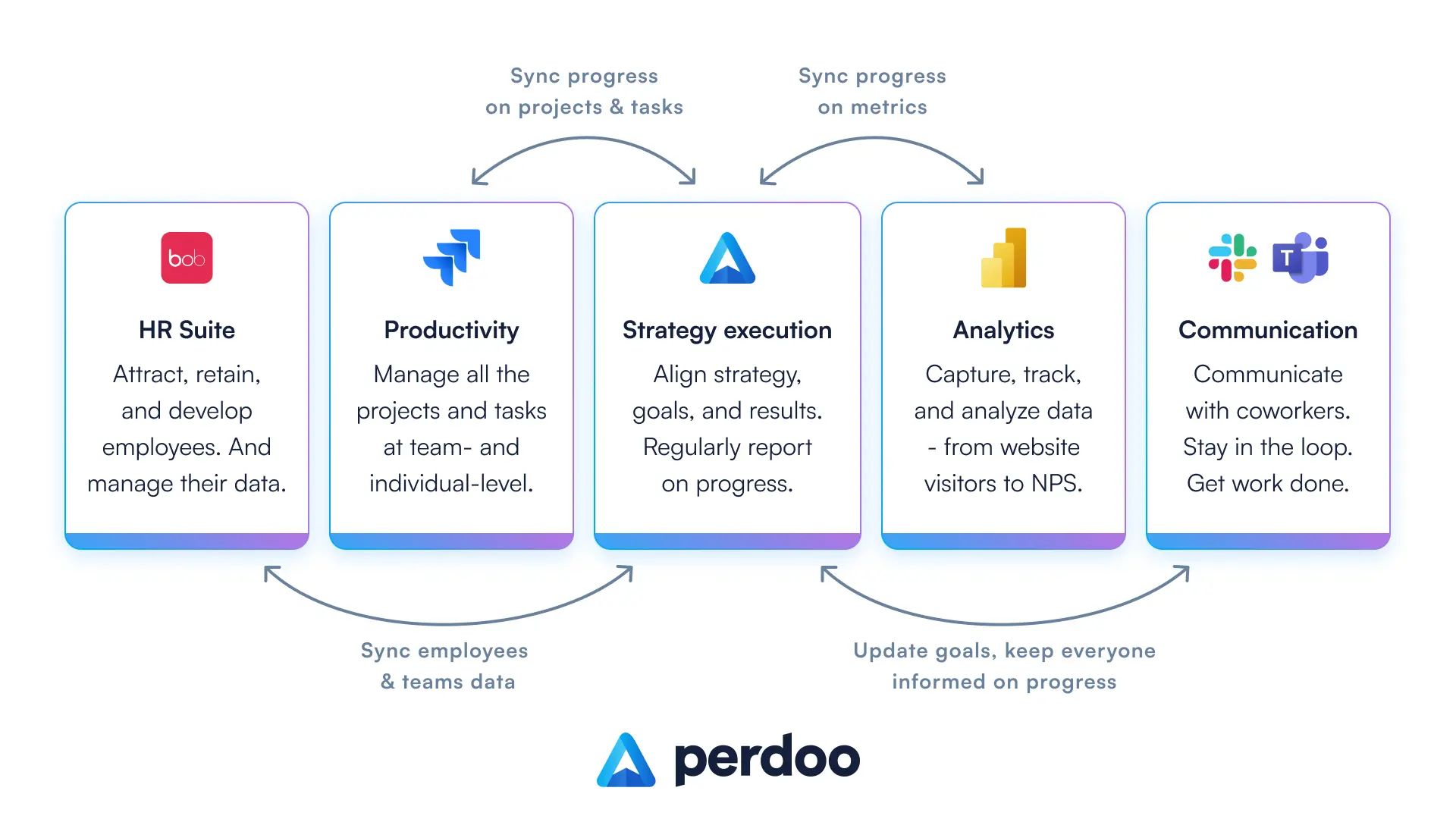
As a small or mid-market organization, you need one solution for everything HR. An HR tool that does not only deal with work documents, payroll, absence tracking, and on/offboarding, but also engagement surveys, career tracks, and more. Basically, everything that you need to do to attract, retain, and develop your employees.
You’ll probably need a variety of productivity tools. Productivity tools, as the name already suggests, optimize the productivity of specific teams or functions. A sales team needs a tool like Hubspot or Salesforce to do their work, engineers need Jira, some marketing teams love Asana whereas others prefer Trello — etc. Unless you’re a team of 10 people, there’s simply no way that your entire organization will work inside the same productivity tool. Heck, it’s probably even undesirable as a generic productivity tool will only increase efficiency for a few. Let the different teams decide which tools are best for them.
Then there are analytics tools to help you capture, track, and analyze the many metrics that are important. You’ll also have a few of those in place: Google Analytics for your company’s website, Delighted to keep tabs on customer Net Promoter Score (NPS), Mixpanel for the usage of your product — and so on. As with productivity tools, it’s best to let the teams decide which analytics tools are best for them.
Lastly, there are communication tools like Microsoft Teams and Slack. They don’t require any explanation.
Perdoo integrates with all these tools. Learn more about our Integrations here.
Costs
[fs-toc-omit]How much does Perdoo cost?
Our pricing depends on 4 questions:
- Do you want our Premium or Supreme plan? Click here to compare.
- How many users do you need? Our prices go down as you add more users!
- How many view-only licenses?
- Do you prefer a quarterly or annual contract? Annual is 15% cheaper.
We've made all our volume discounts up to 500 users public. You can use our online calculator to calculate your costs.
Need more than 500 users? Get in touch.
Return on investment
Let's talk ROI.
- 95% of employees are unaware of, or do not understand, their company’s strategy (Harvard Business Review).
- No surprise that 9 out of 10 companies fail to execute their strategy (Kaplan & Norton).
- On average, companies estimate that employees spend 2 days per week on work with little to no strategic relevance.
- Let’s say it’s only 1 day per week: that’s 20% of efforts that have no (long-term) value.
- Perdoo’s solution is simple: For each person that you add to your account, Perdoo will make sure that their work is strategically relevant and that they’ll achieve the goals that will drive your strategy forward.Now let’s look at management and assume an avg. salary of $50K. 20% then equals $10K per manager/year.
- Perdoo costs only $120 per user/year.
- Our customers observe a 50% reduction in wasted efforts. That’s $5K per manager/year. $5k / $120 = 42. That’s a 42x return on investment.
Even if Perdoo would increase the amount of work with actual strategic relevance by only 1.2%, it would already pay for itself.
And then not to mention the upside of a successfully executed strategy: a strong market position that differentiates your business from the competition and is defensible.
Getting started with Perdoo is a no-brainer.
[fs-toc-omit]Ready to upgrade? Here's what's next!
One of the things that makes Perdoo stand out is the quality of our resources and support.
Here are 5 out of the 9 services that you'll get from us after upgrading:
- Dedicated Customer Success Manager
You'll be assigned a dedicated Customer Success Manager who will work closely together with you to make the implementation of Perdoo a resounding success. - Super fast, live chat support
Everyone in your Perdoo account will get free access to our live support chat. Our average response time is less 10 minutes and customers rate it a 9 out of 10. - Guided onboarding session
Enjoy a guided onboarding session with your Success Manager. Discuss your implementation plan, best practices, and ask them anything! - Online OKR course
Everyone will get free access to our online OKR course where they'll not only learn about OKRs, but also KPIs and Strategy. If successful, they'll earn a certificate. - Onboarding audits
After 2 weeks, 1 month, and 3 months, we'll audit your account. We'll provide detailed feedback and advice on how to get the most out of strategy execution and Perdoo.
Curious to see what else is included? Learn more here.
FAQ
Who in my company needs a license?
Strategy execution is about executing strategy. So you need both the people that drive the strategy (senior leadership — C-level, board) as well as the ones that drive execution (management — your VPs, heads of, and team leads).
Of course, employees also play a critical role in execution — but you don’t need to involve them right from the start. Especially when you’re new to things like strategy execution and OKR, it’s best to go for a gradual, top-down rollout.
You also need someone to assume operational responsibility for Perdoo and your strategy execution program. We call this person the Ambassador. They will be the main point of contact for your Perdoo Customer Success Manager. Together, they’ll complete the technical setup of your account, import your users and groups, configure the integrations, etc. And together they’ll make sure this partnership will become a success!
How long does it take to get fully up and running?
The technical setup of your account will only take a few hours.
The setup of your strategy will be a matter of minutes — IF you already have a clear strategy. If not, you’ll probably need to spend some time sharpening your strategy and figuring out your Strategic Pillars (more on that below).
Then you need to add your goals. Adding these to Perdoo is easy if you have them already documented somewhere. If you still need to figure out all your KPIs and OKRs, then this will take some time.
Perdoo is also a customizable product and certain processes will have to be tailored to the specific needs of your organization. Figuring out the approach that’s best for your company could take 1 to 2 quarters.

Ready to get started?
Free for up to 5 people.