
Watch a quick walkthrough or book a demo
Request successful.
Our team will contact you within one business day.
Pick a time that works for you and we'll send the invite.
Oops! Something went wrong while submitting the form.
Sign-up successful!
Check your inbox for a link to activate your free Perdoo account.


Henrik van der Pol
2
min
read
Usually, when people have to create OKRs for the first time, they search the internet for help. They then run into all sorts of rules such as “every Objective should have 3 Key Results”. The problem with these rules is that they’re sometimes difficult, if not impossible, to apply. They should, therefore, be taken for what they actually are: best practice.
If Objectives tell you where to go, Key Results are what you need to achieve to get there. Key Results are like a GPS that you follow in order to navigate to where you want to be. Where a GPS needs 3 satellites to accurately pinpoint your location, an Objective requires 3 Key Results to accurately let you know whether or not you’ve accomplished it.
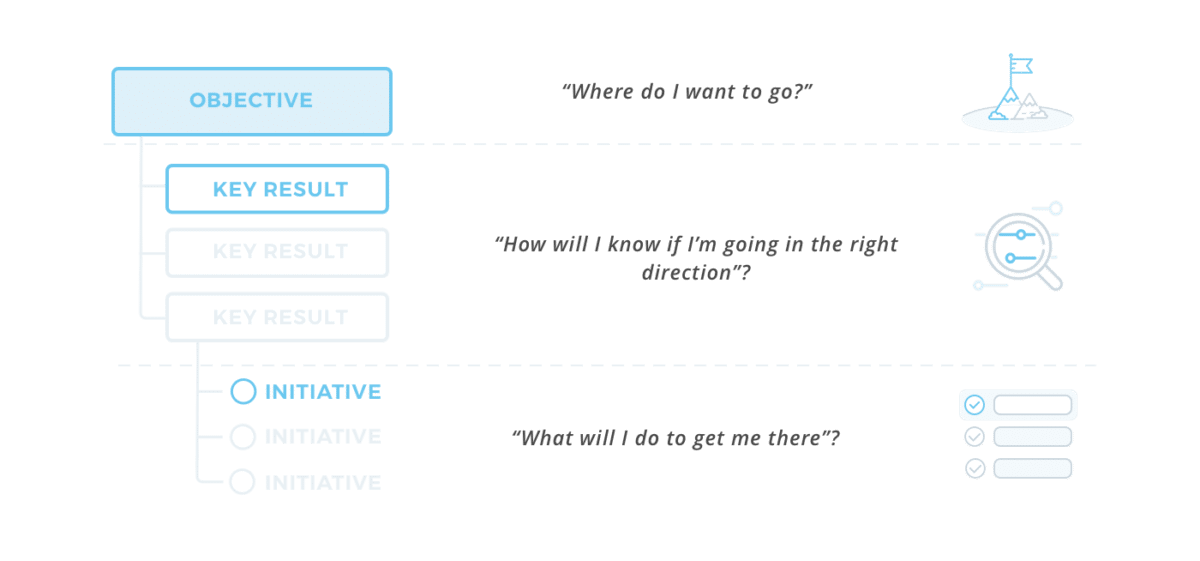
However, every company and team is unique, and the challenges that they face can vary greatly. Sometimes this means that 6 Key Results are required for an Objective, which is totally fine. It can sometimes also be the case that you only need 1 or 2 Key Results for an Objective. Again, not a problem. What really matters is that you don’t end up with too many Key Results overall, when you take all your Objectives for the quarter into account.
One of the primary motivations for organizations choosing OKR is to increase focus. Focus means that you have to say no to things. If you have 2 Objectives with 6 Key Results each, you’ll have 12 Key Results in total. If you have 4 Objective with 3 Key Results each, you’ll also have 12 Key Results. Since teams typically set OKRs every quarter, 12 Key Results more or less means your team has only 1 week to deliver a Key Result. Any more than 12 and you risk losing focus. We have seen that 12 is the maximum a team is able to achieve consistently. If you have more than 12, you either struggle to focus or Key Results have become too granular.
Instead of focusing on the number of Key Results for an Objective, focus on the total number of Key Results that you end up with for a quarter. Moreover, make sure that the Key Results you set truly are truly representative of a measure of what you want to accomplish. Key Results should always show you whether your Objective was actually achieved. The maximum number of Key Results for your team depends on how much time you’ll have to work on your OKRs. In most circumstances, 12 Key Results per quarter would be the absolute maximum.

Ready to get started?
Free for up to 5 people.