
Sign-up successful!
Check your inbox for a link to activate your free Perdoo account.
Watch a quick walkthrough or book a demo
Request successful.
Our team will contact you within one business day.
Pick a time that works for you and we'll send the invite.
Oops! Something went wrong while submitting the form.


The Ultimate KPI Guide: What They Are, How to Set Them, Examples
15
min
read
Introduction
An introduction to KPIs
KPIs are among the most commonly used goals within organizations worldwide. They’re a critical ingredient for organizational growth and long-term success. And, while it’s such a fundamental type of goal for so many organizations, KPIs are often misunderstood and used incorrectly.
This guide provides you with a deeper understanding on: what a KPI really is, how to use them correctly, defining KPIs that work best for your organization, and the best practices to get the most out of them.
[fs-toc-omit]What is a KPI?
KPI stands for Key Performance Indicator. It’s a type of performance measurement, aimed at evaluating the success of an ongoing process or particular activity.
KPIs are quantifiable measures of performance for the efforts and activities that are key to an organization or team. These are all the activities that you need to monitor and measure on an ongoing basis to keep the lights on — your business as usual. For that reason, KPIs are often referred to as “health metrics.“
[fs-toc-omit]A brief history of KPIs
While the exact origin of KPIs remains a mystery, its roots date back to the Wei Dynasty in China during the 3rd century. They used a 9-rank system to evaluate the performance of the royal family.
The next milestone was the creation of Return on Investment (ROI) — the father of KPIs — first used by Venetian traders during the 13th century. They compared the sums invested in their sailing expeditions with the goods the ships brought back.
The institutionalization of KPIs, however, began with the creation of the first so-called “KPI dashboard” at a Scottish cotton mill in the 1800s. Different colored wooden cubes were used as monitors of performance above each laborer’s workstation.
By the early 20th century, organizations began formally measuring the performance of their employees through the concept of ROI. Soon after, France created Tableau de Bord, a strategic measurement system — similar to the Balance Scorecard created by Dr. Norton and Dr. Kaplan — used to measure overall company performance.
Not long after, the term KPI was coined, making its way into the performance toolbox of organizations as a whole. As you can see, organizations tended to use the previous frameworks to measure the performance of an individual and their ongoing activities. Now KPIs are a tool used to measure the health of an organization and its respective teams and departments.
[fs-toc-omit]The benefits of working with KPIs
Organizations experience a plethora of benefits by using KPIs — a lot of which you’ll witness throughout this guide. However, here are three of the core benefits an organization can expect:
Make better decisions
Tracking the progress of KPIs over a period of time means that the organization and its teams have a clear window into the priorities of the organization, its health and they can easily identify trends, strengths, weaknesses, and opportunities. Having this information at hand gives you the opportunity to make better, calculated decisions.
Create focus
KPIs by definition are your most important health metrics. They should be carefully hand-picked by closely reflecting on the organization’s strategy and priorities. In doing so, your KPIs transparently communicate what is expected from your people, what should be kept top of mind and how they should carry out their day-to-day activities.
Create an environment of learning
Having all the most critical information in front of you sheds light on areas that otherwise would have been overlooked. It gives context when things are either not going as planned or are doing well.
When a KPI is unhealthy, teams and people are forced to take a deep-dive into understanding why and what is causing the area of the business to be unhealthy and ensure they find ways to innovate in order to bring it back on track again.
Who uses KPIs?
Any organization or team, irrespective of size, stage or industry can essentially use KPIs. An organization is like a machine and a machine has several parts that perform different functions to keep the entire machine running. Multiple departments work on various tasks to contribute to the organization’s mission and vision. Therefore, the organization and its respective departments should use KPIs to ensure their ongoing health.
KPIs, therefore, should be implemented at all levels to ensure the organization is a well-oiled machine. As such KPIs are set at both a high (company KPIs) and low level (team KPIs) to provide complete visibility over the health of the organization.
Having said that, before getting into the details, it’s important to understand the importance of strategy in this entire equation.
[fs-toc-omit]The importance of strategy
Let’s face it: without a clear strategy in place, any goals an organization tracks will likely have little to no purpose. Reason being, how would you know that those goals are the right ones? And, how will you benefit from measuring the performance of a specific area of your business if you’re not even sure it’s a key area for your organization's success?
Your strategy is a composition of your Ultimate Goal and Strategic Pillars. The Ultimate Goal defines the overall purpose of your organization, for whom the organization is fulfilling that purpose and when you’ll consider the organization successful. This strategy is supported by a set of how-to-win choices or “pillars” that explain what differentiates you in the market and why you’d be chosen over your competitors.
So before getting started with KPIs, make sure your strategy is in place to provide a solid foundation that inspires all the KPIs (and OKRs) your organization will work on. It provides the direction needed to set KPIs that truly matter to your organization.
Note: KPIs don’t necessarily have a due date — they measure the health of ongoing activities and processes. Since your strategy is practically eternal and has no due date either, your Strategic Pillars should be measured using KPIs.
[fs-toc-omit]Company KPIs
Company KPIs are essentially strategic — they measure the performance of the organization as a whole over a period of time. Such KPIs are set by closely reflecting on the strategy.
Company KPIs typically don’t change too rapidly and therefore, there’s value in monitoring their progress and trajectory over time.
Some examples of company KPIs include:
- Revenue
- Gross profit margin
- Employee NPS (eNPS)
- Monthly Recurring Revenue (MRR)
- Churn rate
KPI examples
Every organization is different, but the departments below appear in most companies — and each one needs its own set of KPIs to stay healthy. The examples below are a starting point. Use them as inspiration, then reflect on what is truly key for your team's health and align them to your organization's Strategic Pillars.
Remember: a KPI only becomes meaningful when it has a defined target value. Without a target, you cannot tell whether performance is healthy or unhealthy.
Finance KPIs
Finance KPIs monitor the financial health of the organization — from cash generation and profitability through to cost control and capital efficiency. Company-level Finance KPIs are typically reviewed by senior leadership as part of the Strategy Map.
Marketing KPIs
Marketing KPIs measure the efficiency and impact of efforts to attract, educate, and convert potential customers. Because marketing activities directly feed the sales pipeline, Marketing KPIs are among the most important team-level health metrics in a growth-oriented organization.
Sales KPIs
Sales KPIs track the efficiency and output of the revenue-generation process. They help leadership and sales managers identify whether the pipeline is healthy, deals are progressing, and revenue targets are achievable.
Customer Success KPIs
Customer Success KPIs monitor the health of the customer base after the sale. Retaining and expanding existing customers is more cost-effective than acquiring new ones, which makes these KPIs strategically critical for any company with recurring revenue.
HR KPIs
HR KPIs measure how effectively the organization attracts, retains, and engages its people. Because people are the foundation of every Strategic Pillar, HR health metrics have an outsized impact on the organization's ability to execute its strategy.
Operations KPIs
Operations KPIs ensure the organization's internal processes are running efficiently and reliably. They are often leading indicators — operational inefficiencies tend to surface in customer-facing and financial KPIs if left unmonitored.
Product & Engineering KPIs
Product and Engineering KPIs track the velocity, quality, and impact of the product development process. These KPIs bridge internal delivery metrics and customer-facing outcomes, making them important for both team health and strategic progress.
[fs-toc-omit]A metaphor for KPIs
Assuming an organization is a human being, how would we measure this individual’s health? The answer is simple: to get a general understanding, we’ll regularly run a set of vital tests — pulse, blood pressure, temperature, etc. If we’re looking to get a better understanding of a specific area of the body — say the heart — we’ll probably run tests such as blood tests, an Electrocardiogram, an Echocardiogram (ultrasound), and the list goes on.
These results provide an understanding of whether everything is ok or if something is wrong and you need to take action to bring it under control again.
Similarly, company KPIs are your organization’s heartbeat. These are the KPIs you’ll need to keep an eye to make sure your organization as a whole is healthy at all times. Department or team KPIs, are the metrics that the specific teams or departments have deemed critical to measure their success and ensure they’re moving in the right direction.
A healthy KPI should be maintained and adjusted if needed, while an unhealthy KPI is a warning that something is not going well and requires attention, needing to be nurtured back to health.
[fs-toc-omit]Getting started with KPIs
The components of a KPI
A KPI consists of the following elements:
- Metric
- Current value (Progress)
- Target value
- Title
Metric
The term “metric” and “KPIs” are often used interchangeably and tend to spark confusion.
Anything your organization measures is a metric. The metrics your organization or teams classify a priority and deem “key” are the ones that are your KPIs.
Some popular metrics for Software-as-a-Service (SaaS) companies are Monthly Recurring Revenue (MRR) and Churn Rate, however, these metrics may, for example, not be important metrics for an eCommerce company.
Current value (Progress) & Target value
The current value and target value require little explanation.
- The current value is simply the value that your metric has presently.
- The target value is the minimum or maximum value that you want that metric to achieve.
Title
The title should consist of the metric and the target value. Right above the title, you can then display the current value, and that’s all the information someone needs to see what the KPI is and if the KPI is healthy or not.
Here is how the Perdoo Sales Team have set up their KPIs:

Watch video
The different types of KPIs
There are several types of KPIs. As previously mentioned, KPIs for each organization and team can look different and in fact, can also be structured in different ways as well.
Here are four of the most commonly known types of KPIs:

Leading KPIs
Leading KPIs present results almost immediately. They can help gauge future trends, however, they often don’t provide a clear picture of the long-term impact. Lagging KPIs (see below), on the other hand, present hard facts that better determine the longer-term impact.
Let’s say you’re selling software, and one of your Marketing team’s KPIs is website traffic. That’s a leading KPI — the amount of visitors to your website can be tracked in real-time and provides a good understanding of where your website stands. Is it telling you if these visitors are interested in your software? Probably not.
And, what’s a website worth if it isn’t spiking interest in your visitors? Here’s where lagging KPIs come to the rescue.
Lagging KPIs
Lagging KPIs are metrics that take some time before the impact can be measured. Such KPIs offer more accurate results when understanding the impact a certain area has on the bigger picture over time. It’s important to note that lagging KPIs may not be the right gauge for teams that require instant feedback on the projects and activities they’re working on.
Coming back to the Marketing KPI example — in comparison to website traffic (leading), monitoring Unique Visitors to Lead conversion rate (lagging) can be a better indicator of a website’s performance.
Quantitative/Tangible KPIs
Quantitative KPIs are straight forward. They’re measured solely by a number, and therefore, are in a way tangible — the truth is, numbers don’t lie. Some examples of purely quantitative KPIs include revenue or profit.
Qualitative/Intangible KPIs
Qualitative KPIs are likely to be based on opinions, traits and properties of certain processes or business decisions. They tend to focus on the “why” and not so much on the “how”
Examples of which include Employee Net Promoter Score (eNPS) or Customer Satisfaction Score (CSAT). Such metrics may be given a number for the purpose of measurement, however, are purely based on qualitative/intangible judgements.
How to set KPIs: A step-by-step process
Identifying the right KPIs is the first half of the challenge. The second half is setting them up in a way that drives real accountability and action. The following five-step process gives you a repeatable framework for defining KPIs that are both meaningful and operational.
Step 1: Identify the right metrics
Organizations and teams are easily tempted to adopt well-known industry metrics without identifying whether those metrics are truly key for their organization. There’s no doubt that they’re a good point of reference, but it’s unlikely to provide the information you need or reflect your business and teams’ performance. So, how do you set KPIs that truly matter to you?
Here is a preliminary question you should be asking yourself and your teams to identify the most important areas.
Do you consider the overall organization and/or certain areas of the organization healthy? Why or why not?
- If not, the metrics to nurture it back to health should be reflected as KPIs.
- If yes, those metrics that tell you that things are healthy should be reflected as KPIs too.
At this point you may even have too many KPIs. Don’t avoid the hard choices on what’s key and what isn’t. In the next screening process, ask yourself:
- Is this really reflecting our most critical business as usual?
- Is this really a metric that we need to be looking at regularly?
Sometimes wanting to track too many metrics is the result of focusing too much on the details — cut that noise out. A few examples to illustrate this:
- An HR team can track eNPS for each department individually, but they can instead track eNPS for the company as a whole. When company eNPS drops below the desired target level, they can then zoom in on the details to see if it’s a problem within a specific department or if the problem exists across the organization as a whole.
- A SaaS business should track the metric MRR in a company KPI, and leave NewBiz MRR to Sales and Churn MRR to Customer Success.
- A Customer Success team could track the metrics Expansion MRR, Contraction MRR, and Churn MRR in separate KPIs, but they could also look at Net MRR Churn Rate which incorporates all 3.
Now that we know what KPIs work best for you, let’s make sure you’re getting the most out of them.
Step 2: Find the best way to calculate progress
There are different ways to calculate the current value and each approach has its own pros and cons. We’ll highlight the differences so you can use the best formula for your given situation.
Rolling X days vs. Fixed timeframes
If you’re focusing on rolling X days, your current value can change every day. If you’re focusing on fixed timeframes, such as monthly or annual, then your current value will only change once that timeframe is completed.
- Do you need to get daily feedback on your KPI?
- Would you like to get immediate feedback when something changes?
Then rolling X days is probably the better option. But if you don’t want to be disturbed too much, checking your KPI once a week or once a month, then a fixed timeframe would be better.
Numbers vs. Percentages
For some KPIs, like your sales target (eg, Close $5 million in deals) it’s obvious that you want to look at numbers. For others, such as Visitor to lead conversion rate, it’s obvious that you want to look at percentages. But for some KPIs this is less clear. Imagine that you need to make sure your Sales people are having enough demos with prospects.
- Will you be tracking the total number of demos booked?
- Will you look at the % conversion rate on your demo booking page?
- Or, will you look at the % availability that your sales team has left?
Each option will have its own pros and cons, so it’s important to decide what exactly you want this KPI to accomplish and then verify if your current setup is accurately reflecting that.
Large vs. Small data sets
The larger the data set that you’re focusing on, the more accurate your number probably is. For example, your NPS for the past 3 months is probably a better indicator of how happy your customers are than today’s NPS.
However, the larger the data set the longer it takes for your current value to move (lagging). If things recently started to deteriorate, you would see that immediately in today’s NPS but it would take much longer before you would see that in your NPS of the past 3 months.
Step 3: Agree on a target value
Now that you know how best to calculate the current value for your metric, it’s time to decide what you want that current value to become: your target value.
The target value tells you what good performance looks like. Without it, the KPI can’t be a useful indicator of performance since you won’t know what good performance looks like.
Less than or greater than
The target value is the minimum or maximum value that you want that metric to have. So you have 2 options for your target value.
Here are some examples:
Greater than or equal to (≥)
- Close ≥ $10 million in deals
- eNPS ≥ 30
- Gross profit margin ≥ 70%
Less than or equal to (≤)
- Gross Monthly Churn ≤ 2%
- Annual Employee Turnover ≤ 10%
- Written-off invoices ≤ €25K
Healthy vs unhealthy
Your target value will define whether the KPI is healthy or not. If the current value exceeds your maximum target value, it will be unhealthy. Same if it drops below your minimum target value. An unhealthy KPI requires attention.
If it stays below your maximum or above your minimum, the KPI is healthy and there is no need to put extra focus on it.
Finding the right target value
It’s not always easy to find the right target value, but industry benchmarks (if available) can point you in the right direction. If your website’s conversion rate is currently at 4% and the industry benchmark states that for companies like yours, 8% is considered a good conversion rate, then you know you probably still have a lot to win with your website.
When looking at industry benchmarks, it’s important to look at benchmarks for companies that are similar to you. If industry benchmarks aren’t available, then you can verify your target value by asking yourself “What if we’re at this target value, will our business still be in good shape?”. For example, if you believe that a lead-to-customer conversion rate of 3% is good, but you know that your business needs to acquire 100 customers per month and your company currently acquires 2000 leads per month, then you know that the numbers don’t add up. You either need to acquire a lot more leads (can you reasonably expect that to happen?) or focus on a lead-to-customer conversion rate of 5%.
Step 4: Make sure everyone understands the KPI
Making sure everyone understands the KPI is essential to ensuring the KPI remains healthy. If no one understands the KPI, they’re likely not going to know how to nurture it back to health (given it’s unhealthy). And, to make sure everyone understands a KPI, you need to provide proper context and ensure that it’s not open to more than one interpretation.
For each KPI, answer the following questions, and store these answers in the KPI so that they’re easily accessible for everyone in your organization:
Why is this a KPI?
This question forces you to think critically about the KPIs that you are creating for your team or company. Your explanation for why you believe this should be a KPI helps others follow your train of thought. It helps them put the KPI into context, which is especially valuable in larger teams and organizations where you don’t have the chance to talk to everyone directly.
How is the current value calculated?
However you calculate the current value, it’s critical that everyone who will be looking at the metric understands how it is calculated. Share your formula.
Explain how you got to the target value
Every KPI should have a target value, and everyone needs to understand why that is the target value. Is it based on a benchmark? Share your sources!
Step 5: Assign clear ownership
Every KPI should have one named owner — the person responsible for monitoring it, flagging issues, and coordinating action when the KPI becomes unhealthy. Shared ownership tends to result in no ownership.
Ownership does not mean that one person is solely responsible for the underlying performance; it means that one person is accountable for keeping the team informed and escalating when needed. In Perdoo, ownership is assigned directly on the KPI so it is always visible to the entire organization.
Step 6: Establish a review cadence
A KPI is only useful if it is reviewed consistently. Decide in advance how often the KPI will be reviewed — weekly, monthly, or quarterly — and make that cadence explicit. Perdoo's Check-ins feature supports regular KPI updates so that the current value stays accurate and conversations happen in context.
At Perdoo, we review all KPIs at the start of each quarter, alongside the OKR planning cycle. This rhythm ensures that KPIs remain aligned with the current strategy and that any KPI that has become irrelevant is retired before it distracts the team.
Common KPI mistakes to avoid
Even organizations with strong strategies stumble when it comes to working with KPIs. Knowing the most common mistakes in advance can save considerable time and frustration.
Tracking too many KPIs
More is not better when it comes to KPIs. If everything is key, nothing is key. When teams track ten, fifteen, or twenty KPIs simultaneously, attention gets fragmented and the signal-to-noise ratio collapses.
At Perdoo, we recommend a maximum of six KPIs per team or department, and a similar number at the company level. Keeping the list short forces the hard but important conversation about what is truly critical — and that conversation is where organizational clarity is built.
Relying on vanity metrics
Vanity metrics are numbers that look impressive but do not meaningfully reflect the health of the business. Total social media followers, cumulative app downloads, or raw page views may all trend upward while the underlying business stagnates.
A reliable test: ask "Can this metric go up while the business gets worse?" If the answer is yes, it is likely a vanity metric. Replace it with an outcome-oriented measure — one that changes only when real business value is created or destroyed.
Having no action plan when a KPI goes off-track
A KPI that turns red and prompts no response is a missed opportunity. Every KPI should have a pre-defined escalation path: who gets notified, what initial diagnosis steps are taken, and — if the unhealthy state persists — how an OKR might be created to address the root cause.
In Perdoo, an unhealthy KPI can be directly linked to an OKR designed to fix it. This closes the loop between monitoring and action, ensuring that a declining KPI translates into a concrete improvement initiative rather than a passive observation.
Defining KPIs without documenting how they are calculated
Ambiguity in calculation methodology is one of the most common sources of KPI dysfunction. When two people in the same team derive different numbers from the same metric, trust in the KPI erodes rapidly.
For each KPI, document the formula, the data source, the update frequency, and any known limitations. Store this context directly on the KPI — in Perdoo, the description field is the right place for this — so that everyone has access to a single source of truth.
Setting a KPI once and never revisiting it
The business environment changes. Priorities shift. A KPI that was critical twelve months ago may no longer reflect a strategic priority today. Failing to review KPIs regularly means the organization continues to optimize for yesterday's goals.
Build a structured review into your quarterly rhythm. At the close of each quarter, ask: Did we look at this KPI? Did it influence our decisions? Is it still aligned with our current Strategic Pillars? KPIs that fail this test should be retired or replaced.
For a more detailed examination of where KPI programs go wrong, see Avoid These 6 Mistakes with KPIs.
KPI Boards: Visualizing performance
Tracking KPIs in a spreadsheet works at small scale, but as the number of teams and KPIs grows, a dedicated KPI dashboard becomes essential. A well-designed dashboard is not just a reporting tool — it is a shared language that enables teams to act on information quickly and consistently.
What makes a good KPI Board?
A KPI dashboard that drives behavior shares several characteristics:
Clarity over completeness. A dashboard that tries to show everything ends up communicating nothing. Display only the KPIs that require regular attention from the audience viewing that dashboard. Senior leadership needs a company-level view; a department head needs team-level visibility. Tailor the view to the audience.
Healthy vs. unhealthy at a glance. The primary job of a KPI dashboard is to surface whether each KPI is healthy or unhealthy — instantly, without calculation. Color-coding (typically green for healthy, red or amber for unhealthy) is the standard mechanism. When someone opens a dashboard, the answer to "Is everything OK?" should be visible in under three seconds.
Trend visibility. Current value versus target value tells you where you are today. A trend chart tells you whether you are moving in the right direction. Both are necessary. A KPI that is currently healthy but declining deserves attention before it crosses into unhealthy territory.
Context alongside numbers. Numbers without context invite misinterpretation. A good KPI dashboard provides the ability to add commentary — explaining why a KPI changed, what actions are in progress, and what to expect in the next review period.
Alignment to strategy. The most powerful dashboards are organized around the organization's Strategic Pillars, so that the connection between day-to-day metrics and the Ultimate Goal is always visible. This alignment is the foundation of Perdoo's KPI Board design.
How many KPI Boards does an organization need?
Most organizations benefit from three levels of KPI dashboard:
- Company KPI Board — shows the organization's most critical health metrics, owned by the leadership team and visible to the entire organization.
- Department KPI Boards — one per team or department, showing the metrics most relevant to that team's ongoing health.
- Strategy Map — brings the organization's Ultimate Goal, Strategic Pillars, and associated KPIs together into a single view, making it easy to see how team-level health connects to the overall strategic direction.
Leading and lagging indicators on a board
A balanced dashboard includes both leading indicators (metrics that signal future performance, such as pipeline value or MQL volume) and lagging indicators (metrics that confirm past outcomes, such as closed revenue or customer churn). Relying exclusively on lagging indicators means you are always reacting to history. Leading indicators give you the opportunity to intervene before a problem fully materializes.
[fs-toc-h2]KPIs vs OKRs
[fs-toc-omit]KPIs & OKRs: a recipe for success
KPIs are often confused with Objectives and Key Results (OKRs). KPIs and OKRs are, in fact, completely different goals that naturally complement each other in facilitating the execution of an organization’s strategy. OKRs can also be used to improve an unhealthy KPI.
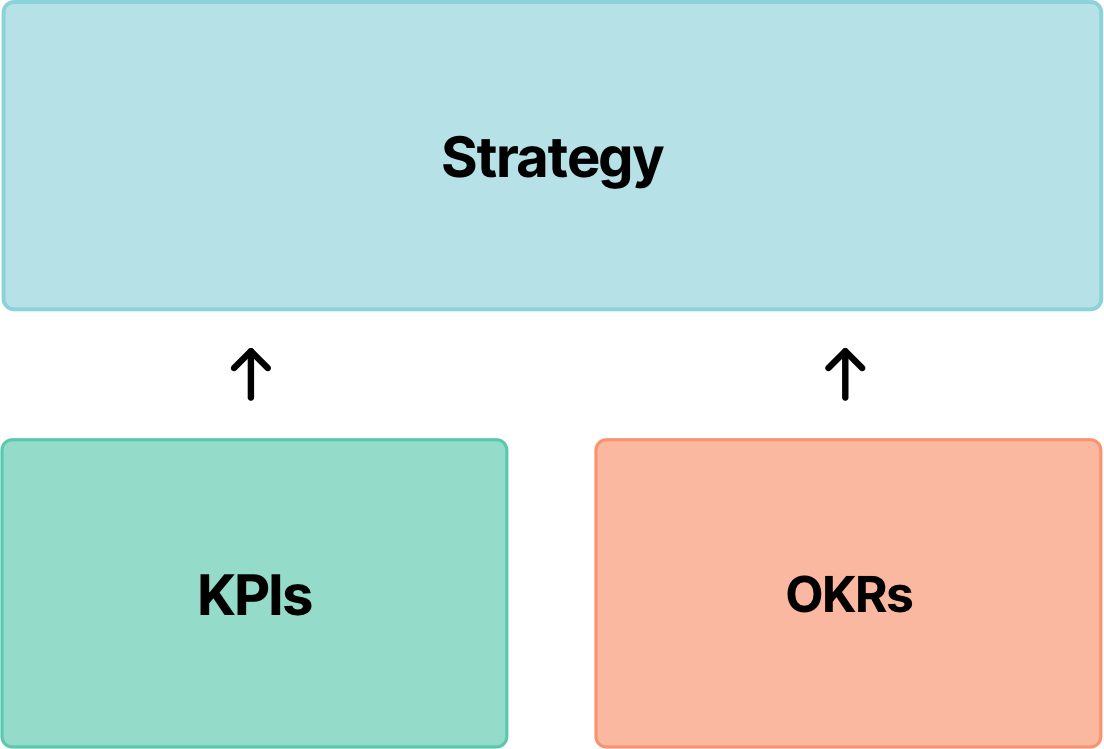
How KPIs and OKRs work together
As you know, KPIs measure the success, the output, quantity, or quality of an ongoing process or activity that is already in place.
OKRs, on the other hand, provide the missing link between ambition and reality. They help you break the status quo and take you into new, often unknown, territory. If you have a big dream—an inspiring Ultimate Goal — for your company, you need OKRs that take you there.
For a deeper look at how OKRs and KPIs differ and complement each other, see OKR vs. KPI — What's the difference?.
Let’s look at OKRs and KPIs as a metaphor. Imagine your organization is a car and you’re driving that car toward a destination (your Ultimate Goal). Your KPIs are what you’ll find on your car’s dashboard, like the fuel gauge and engine temperature gauge. These are things you’ll constantly need to watch. In contrast, OKRs are like your roadmap. They’ll guide you to your destination. OKRs are temporary, they’ll change from time to time. Once you’ve passed a landmark toward your destination, you’ll focus on the next one.
An organization needs both KPIs and OKRs. If you were only watching KPIs, you’d have no clue how you were advancing toward your destination. Had you only been watching OKRs, you wouldn’t see that you’re running out of gas.
Cheat Sheet KPIs vs OKRs
Our free Cheat Sheet conveniently summarizes the differences between OKRs and KPIs for you.
OKRs can become KPIs (and vice versa)
There can be a strong relationship between KPIs and OKRs. OKRs can turn into KPIs, and KPIs can be fixed through OKRs. This is one of the reasons why many organizations choose to track KPIs and OKRs alongside each other.
Here’s an example of how an OKR became a KPI. In the previous quarter, our Marketing team was working on an OKR to optimize our website’s conversion rates.
We ran all sorts of experiments to increase the performance of our website and convert more website visitors to leads.
The OKR was a great success. We gave our conversion rates an initial boost thanks to the tests we ran. Nevertheless, since our website is the main place where people can learn about us and where we can learn about those people, it’s always going to be important that the conversion rates are as high as possible.
Since we believe there’s always room for improvement, we’ve decided that running experiments (with the aim to increase conversion rates) should become business as usual for our Marketing team. Therefore, a new Marketing KPI was created to safeguard the constant tweaking and optimizing of our website’s conversion rate. This KPI, Optimize website conversion rate by 5% per month, makes sure that running experiments with the aim to increase conversion rates becomes business as usual.
It can also work the other way around — an OKR can also be used to fix an unhealthy KPI. For example, we also have a Marketing KPI that tracks the overall conversion rate of our website. We want this KPI to be at 7% or higher. That means that as long as 7% of our website visitors convert to a lead, we’re all good and Marketing doesn’t need to put extra focus on this.
Should this KPI show that the conversion rate drops below 7%, Marketing could make it a priority to fix this KPI and bring the overall conversion rate back to the desired level. In other words, Marketing could create an OKR to fix this KPI.
Tracking KPIs
KPIs in Perdoo
KPI dashboards are where all your most critical business-as-usual metrics come together. They help visualize what ongoing success looks like and what needs to be done to support the health of the organization.
In Perdoo, to truly boost transparency and get a full picture of each team’s priorities, you’ll be able to track your company and group-level (team and/or department) KPIs alongside your strategy and OKRs. When using OKRs to drive you toward your Ultimate Goal, KPIs let you know that your business is in tip-top condition and equipped to get you there. And if a KPI's unhealthy, you can use an OKR to get it back on track. Discover how Perdoo's OKR Software connects your KPIs and OKRs in a single, strategy-aligned view.
Perdoo lets you effortlessly monitor your KPIs and base decisions on concrete data. Integrate with 65+ business apps for automatic syncing and check any report or dashboard for a real-time overview of your KPI health. When viewing any KPI, charts help you spot trends over time, so you can act early to get an unhealthy KPI back on track. On each KPI you'll see a list of aligned OKRs, to communicate what's been tried to push each KPI forward. With KPIs and OKRs in Perdoo, your organization is fully equipped to realize your strategy.
Strategy Map places your organization's strategy right at the top. This not only creates a space for the organization and teams to align its goals to the strategy but also clearly highlights the areas that need attention and can be brought back to health by either creating or adjusting the required KPIs and OKRs.
Learn more about how Perdoo's Strategy Execution Software brings strategy, KPIs, and OKRs together."
[fs-toc-h2]FAQ
[fs-toc-omit]Frequently Asked Questions
KPIs and metrics. What’s the difference?
The terms metrics and KPIs are often used interchangeably, but they shouldn't be confused. Metrics can be used to track any business process — simply put, they're tactical. KPIs, however, are set in line with your organization's strategy, which means they're all the metrics that help your organization and teams achieve its Ultimate Goal. A metric can be a KPI if it's truly key in helping your organization or team stay healthy.
KPIs and Key Results. What’s the difference?
Key Results are a core component of an OKR. A Key Result makes an Objective measurable, defining which results need to be achieved to get to your Objective. OKRs are the goals that help you advance and break the status quo. KPIs on the other hand are a separate goal — they're a performance measurement, aimed at evaluating the success of an ongoing process or particular activity. To learn more about the difference between OKRs and KPIs, head over to this article: OKR vs. KPI To get an in-depth understanding of the difference between KPIs and Key Results and how they're anatomically different, head over to this article: The difference between metrics, KPIs and Key Results.
Do KPIs always include a number?
In short, yes. KPIs are measures that help you track progress of your critical business as usual. Without a current and target value you won't be able to measure where your business or team stands and you won't be able to measure the health of the specific KPI.
How many KPIs should I have?
Organizations produce overwhelmingly large sums of data on a daily basis. It’s tempting to want to track and measure everything, but is all that data “key” to keeping the lights on? Probably not. That’s why it’s crucial to make sure you’re measuring what truly matters. To maintain focus and ensure you're tracking what's most important, our recommendation is to identify up to 6 Key Performance Indicators each, whether it’s for teams or the organization as a whole.
What are some Marketing KPI examples?
Finding the right KPIs for your team can be challenging. Here are some example metrics to help you set the right Marketing KPIs:
- Customer Acquisition Cost
- Cost per Lead
- Unique Visitor to Lead Conversion Rate
- Customer Lifetime Value
- Traffic growth
Note: Each team's needs are different, which means the KPIs it needs to maintain its health will also differ. Use these as inspiration, but don't forget to reflect on what your team truly needs!
What are some Sales KPI examples?
Finding the right KPIs for your team can be challenging. Here are some example metrics to help you set the right Sales KPIs:
- Sales Revenue
- Sales Qualified Leads to Customer Conversion Rate
- Average Deal Value
- Average Time to Close
- Revenue per Sales Representative
- Opportunity Funnel Value
Note: Each team's needs are different, which means the KPIs it needs to maintain it's health will also differ. Use these as inspiration, but don't forget to reflect on what your team truly needs!
What are some Customer Success KPI examples?
Finding the right KPIs for your team can be challenging. Here are some example metrics to help you set the right Customer Support & Customer Success KPIs:
- Customer Support:
- First Response Time
- First Contact Resolution
- Average Resolution Time
- Abandoned Call Rate
- Customer Satisfaction Score
- Customer Success:
- Customer health score
- Expansion Revenue
- Customer Retention Rate
- Customer Referral Rate
- Number of Customers Successfully Onboarded
Note: Each team's needs are different, which means the KPIs it needs to maintain it's health will also differ. Use these as inspiration, but don't forget to reflect on what your team truly needs!
What are some HR KPI examples?
Finding the right KPIs for your team can be challenging. Here are some example metrics to help you set the right HR KPIs:
- Average Time to Hire
- Average Tenure
- Overtime Hours
- Cost Per Hire
- Employee Turnover Rate
- Employee Referral Rate
- Employee Engagement Score
Note: Each team's needs are different, which means the KPIs it needs to maintain it's health will also differ. Use these as inspiration, but don't forget to reflect on what your team truly needs!
How often should you review KPIs?
KPIs should be reviewed at least quarterly — ideally at the same time as your OKR planning cycle so that KPIs and strategic priorities stay in sync. At Perdoo, we review all KPIs at the beginning of each quarter: retiring those that are no longer relevant, adjusting target values where the business environment has changed, and confirming that each KPI still reflects a genuine health priority.
Between formal reviews, individual KPI owners should monitor their KPIs on a weekly or monthly basis, depending on how quickly the underlying metric moves. Use Perdoo's Check-ins to record updates and flag issues as they arise, rather than waiting for the quarterly review to surface problems.
How do KPIs relate to strategy?
KPIs are the measurement layer of your strategy. Your strategy consists of your Ultimate Goal — the long-term purpose and ambition of the organization — and your Strategic Pillars, which define how you will win. The KPIs you set should reflect the most critical ongoing activities that support those Strategic Pillars.
When your strategy changes, your KPIs should be reviewed and updated to reflect the new priorities. A KPI that was relevant under the previous strategy may no longer be key — and keeping it in place creates a false sense of coverage while distracting teams from what actually matters.
Perdoo's Strategy Map places the Ultimate Goal and Strategic Pillars at the center of your goal-setting framework, making it straightforward to see whether each KPI is genuinely aligned to the strategy or simply inherited from a previous planning cycle. To understand how OKRs and KPIs work together to execute strategy, visit OKR Software and Strategy Execution Software.

Ready to get started?
Free for up to 5 people.