
Watch a quick walkthrough or book a demo
Request successful.
Our team will contact you within one business day.
Pick a time that works for you and we'll send the invite.
Oops! Something went wrong while submitting the form.
Sign-up successful!
Check your inbox for a link to activate your free Perdoo account.


Zahra Currimbhoy
4
min
read
On 1st July 2021, at the virtual launch of the “Makers of Tomorrow” program, special guest and chancellor of Germany, Angela Merkel, asked with a frown on her face: “What does OKR mean?”
How OKR came up
Makers of Tomorrow is a digital program designed to promote entrepreneurship in Germany in the form of an online study course.
A handful of startup founders inaugurated the event by introducing their startups and experiences along the way. At one point, the moderator, Ole Tillmann, asked Eva-Maria Meijnen, co-CEO of PlusDental, how they maintain focus with the fast-paced development in the dental industry and all the opportunities around.
Meijnen mentioned that her organization works with OKR to help maintain focus and ensure continuous innovation. At this point, Angela Merkel’s brows were tightly knit because an unknown 3-letter word had been flung her way. She then inquisitively asked: “Was heisst OKR?” (“What does OKR mean?”)
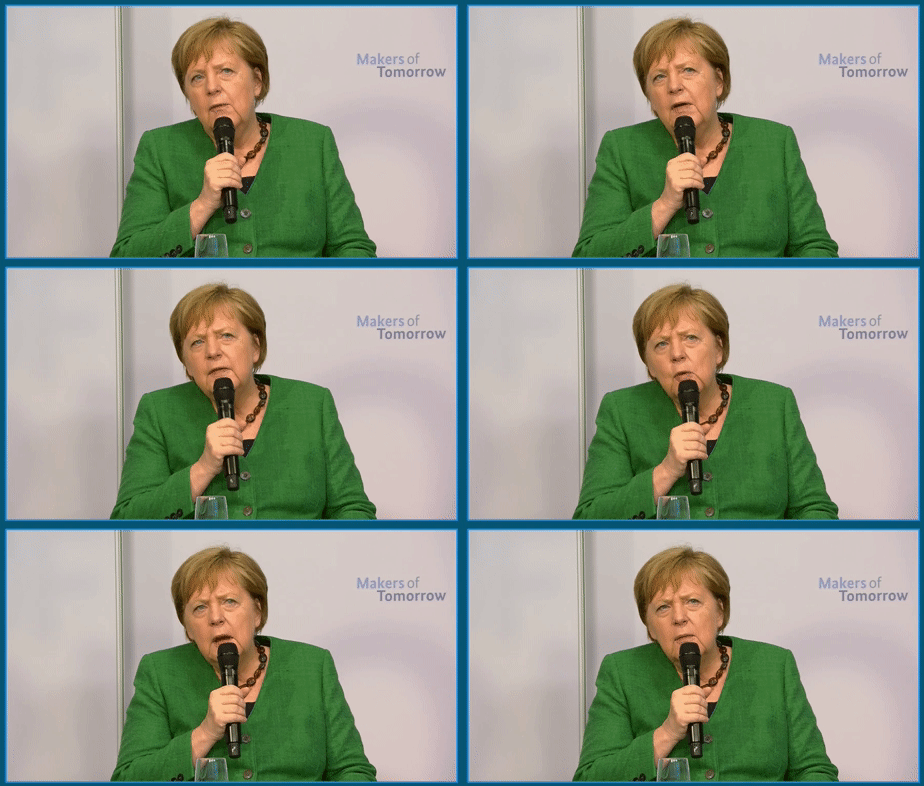
Head over to the video to watch this monumental moment (23:55 to be exact): https://www.bundesregierung.de/breg-de/mediathek/makers-of-tomorrow-1938844
Merkel, we’re here to answer that for you!
What does OKR mean?
Angela Merkel, and anyone in the same boat, the team at Perdoo would be honored to give you a quick crash course on OKR. We can guarantee that even a country like Germany could benefit greatly by working with a framework like OKR.
OKR stands for Objectives and Key Results. It’s a goal management framework that can be used by any organization (or country/state) — regardless of size, purpose, industry, region — to help deliver strategy.
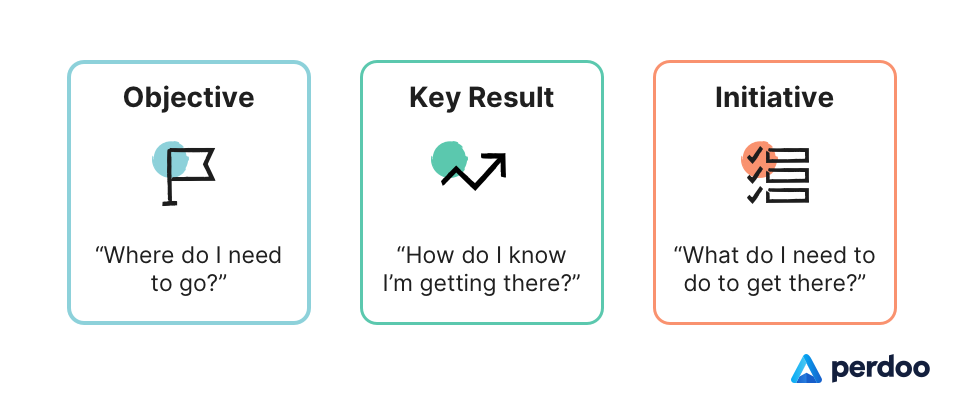
So, what is an OKR? OKRs are made up of 3 components: an Objective, Key Results, and Initiatives.
- Objectives describe something that you’d like to achieve in the future. An Objective sets the direction — like a destination on a map.
Simply put, an Objective answers the question: “Where do I need to go?”
- Key Results are measurable outcomes required to achieve your Objective. It contains a metric with a start and target value. They measure progress towards the Objective — like a signpost that shows how close you are to your Objective.
Key Results answer the question: “How do I know I’m getting there?”
- Initiatives are all the projects and tasks that will help you achieve a Key Result.
Initiatives answer the question: “What will I do to get there?”
Imagine your organization is a car. The Objective is your destination, the Key Results show if you’re heading in the right direction, and the Initiatives are what you’ll do to get your car moving.
Putting OKR to practice: an example
As the chancellor of Germany and a scientist by profession, you likely have many challenges that could be solved with OKR: environmental goals, managing public debt, education, infrastructure, the list goes on.
Having said that, we do have an example that might help you better understand the framework and how it works in practice.
Objective: Protect Germany from Covid
Key Result: Bring death rate down from 2.4% to 0%
Initiative 1: Administer vaccines through more avenues (ie. pharmacies, event spaces, sports arenas)
Initiative 2: Create vaccine education programs
Initiative 3: Implement tighter border control for incoming travellers from risk areas
Why use OKR?
The hard truth is that 9 out of 10 organizations fail to fully implement their strategies. And, in 70% of these failed cases, the problem isn’t bad strategy, it’s bad execution. You’ve probably witnessed this first-hand — leading a country is no easy task. Therefore, you probably know well that implementing strategy and realizing growth is complex, and that’s where OKR comes to the rescue. As PlusDental’s Meijnen mentioned, OKRs increase focus and ensure continuous innovation. But that’s not all.
OKR puts strategy first. Once your organization has defined a clear direction, OKRs are goals that perfectly align to your strategy and help plan and prioritize how teams and your organization as a whole will contribute to delivering it. It ensures everyone is moving in the same direction (the focus part).
OKRs create a common language within an organization, communicating the bigger picture in a way that everyone understands. Through such transparency and clarity, your people can easily identify with the purpose of the organization. And this boosts employee engagement.
How Perdoo can help
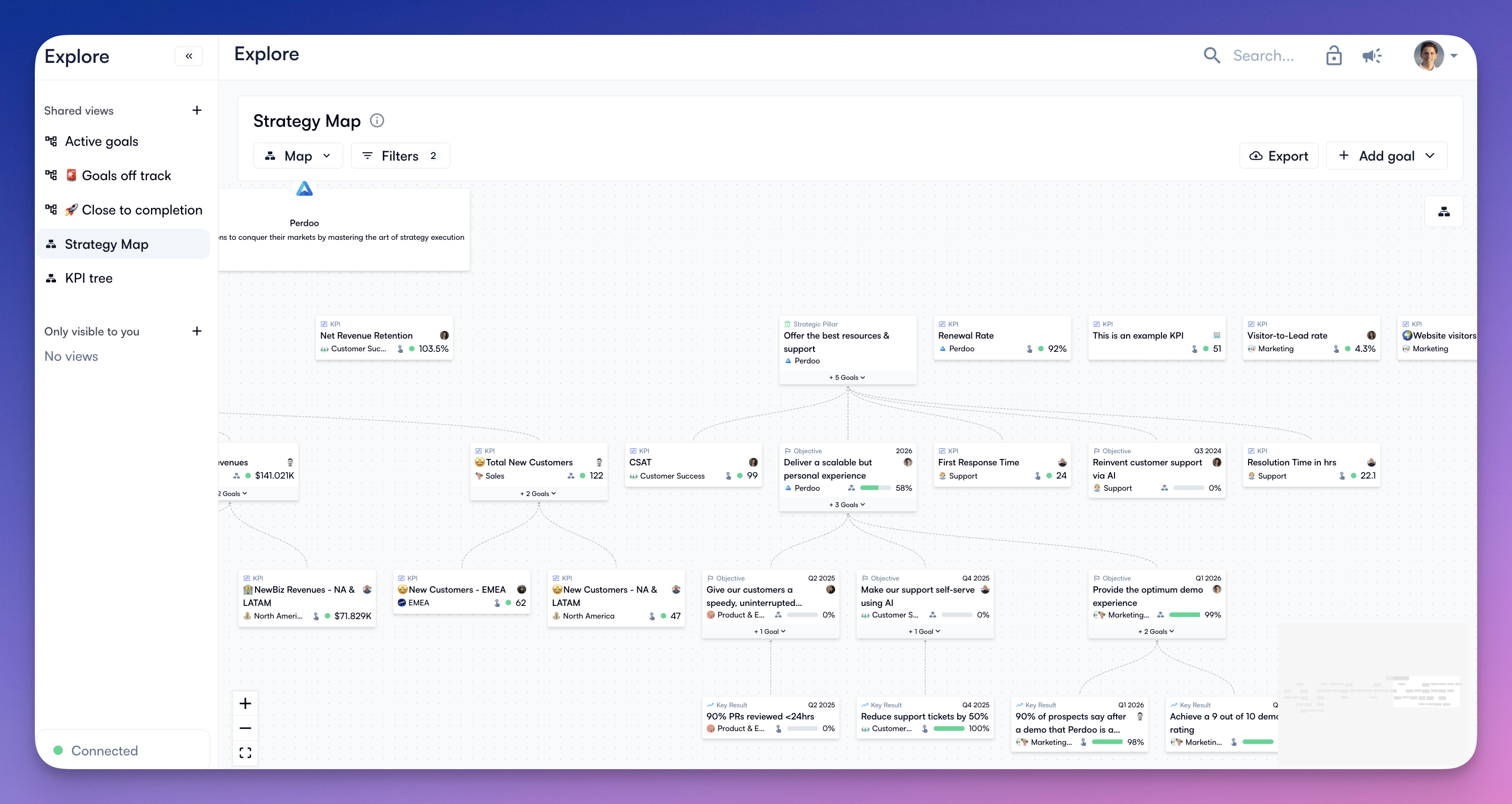
Perdoo’s Strategy Map puts your strategy at the very top, helping everyone understand how they contribute to the big picture, so they can identify areas for collaboration.
Oftentimes organizations wait a full year to plan out their strategy execution. No need to wait that long! Strategic Timeline gives you the tools to plan on a quarterly basis and adjust as you go.
To surface key insights and help you and your teams anticipate challenges early, our robust reporting provides the insights you need, faster. And to keep on top of your goals, customizable Check-ins offer a focused space to review progress in MS Teams, Slack, on your mobile, or in the web app.

Ready to get started?
Free for up to 5 people.