
Watch a quick walkthrough or book a demo
Request successful.
Our team will contact you within one business day.
Pick a time that works for you and we'll send the invite.
Oops! Something went wrong while submitting the form.
Sign-up successful!
Check your inbox for a link to activate your free Perdoo account.


Henrik van der Pol
1
min
read
Key Takeaway: A KPI (Key Performance Indicator) is an outcome-based tracking mechanism that defines what your business as usual needs to achieve. Business as usual consists of the processes you run on an ongoing basis. A KPI consists of a metric, a current value, a target or threshold value, and a title. The metric makes it measurable, the current value shows where you stand, and the target or threshold tells you whether the KPI is healthy. Give each KPI a clear, descriptive title, so anyone in your organization can instantly see what it measures and whether it's on track.
A KPI, Key Performance Indicator, is an outcome-based tracking mechanism that defines which results your Business As Usual is required to accomplish. Business As Usual typically consists of processes that you execute on an ongoing basis. A KPI, therefore, defines what your critical Business as Usual is (or should be) and enables you to easily monitor if it’s successful.
A KPI is an important instrument for every results driven organization. This article explains the components that make up a KPI.
The components of a KPI
A KPI consists of the following elements:
- Metric
- Current value
- Target or Threshold value
- Title
Metric
The metric is what makes the KPI measurable. Popular metrics for product and customer success teams are Net Promoter Score (NPS) and Monthly Active Users (MAU). Software-as-a-Service companies often look at Monthly Recurring Revenue (MRR) and Churn Rate.
It’s important, of course, that you are able to track the metrics that you're using in your KPIs.
Current value & Target or Threshold value
The current value and target value require little explanation. The current value is simply the value that your metric has at any given point in time. The Target or Threshold value is the minimum or maximum value that you want that metric to have.
Title
The title should consist of the Metric and the Target or Threshold value. Right above the title, you can then display the Current value, and that's all the information someone needs to see what the KPI is and if the KPI is healthy or not.
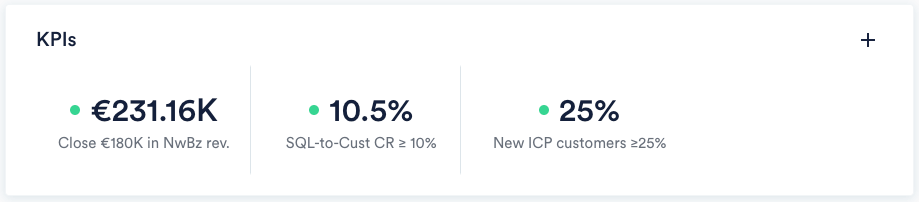
Here is how the Perdoo Sales Team have set up their KPIs:
Are you a Perdoo user?
Take a look at how you can add Company and Team KPIs in Perdoo in order to see the full picture and drive business success.
Watch video

Ready to get started?
Free for up to 5 people.