
Watch a quick walkthrough or book a demo
Request successful.
Our team will contact you within one business day.
Pick a time that works for you and we'll send the invite.
Oops! Something went wrong while submitting the form.
Sign-up successful!
Check your inbox for a link to activate your free Perdoo account.


Henrik van der Pol
8
min
read
Key Takeaway: From "are we mature enough?" to "will this just be more work?", these are the 5 questions our team hears most often from organizations evaluating Perdoo. The answers might surprise you.
1. Is my organization mature enough for Perdoo?
Bruce L., COO at an organization currently evaluating Perdoo, asked: "During Friday's leadership meeting a comment was made that our business isn't (yet) 'mature' enough for something like Perdoo. I'd be interested if you've ever heard this before from other prospects/clients."
We get this one a lot.
The answer is simple: you don't need to be "mature" to make Perdoo work. This isn't wine or cheese we're talking about. Perdoo can be exactly what helps your organization grow up and get its act together. Struggling with static strategies and sluggish execution? Looking to improve focus, accountability, and alignment? Wasting too much time on reporting progress? That's precisely why we exist.
Yes, we sometimes hear organizations say they're "not mature enough" for dedicated OKR software like Perdoo, as if we only work with strategy superstars and goal-setting gurus. Truth is, if you were already perfect at strategy execution, you probably wouldn't need us.
Think of Perdoo like a gym membership. Sure, you could wait until you're already fit to join, but that's missing the point. You join because you want to improve, and we've got the tools and expertise to help.
The real requirement is a willingness to improve
Perdoo works best when leadership wants to create clarity and focus. You don't need a fully-formed strategy or OKRs set in stone. You just need the ambition to get your entire organization working in the same direction, the drive to turn promising strategies into real results, and the openness to work differently.
Many of our most successful customers started from scratch. No OKRs, no clear strategy, just a belief that things could — and should — be better.
If "maturity" means bureaucracy, no thanks
Some organizations confuse maturity with layers of process, endless planning cycles, and slow decision-making. That's not us. We help you stay agile, get everyone on the same page, and focus on what actually moves the needle.
So if you've ever felt "not ready" for Perdoo, ask yourself: are you ready to try something that works? If so, you're more than ready.
2. Will Perdoo create extra work for my organization?
William B. from a well-known European scale-up sent us the following message: "Our team is concerned that Perdoo creates extra work. We all already have a lot to do, and it seems that Perdoo just adds to it."
If your team feels like Perdoo adds more work, you're not alone. And you're not entirely wrong. But the real question isn't whether Perdoo adds work, it's whether the work you're currently doing is worth doing. Perdoo doesn't pile things onto your plate, it helps you clear it.
At first glance, Perdoo can feel like that new fitness tracker your friend swears by: shiny, promising, but also asking you to log your every step, breath, and oat milk latte. Your team's initial reaction? "Ugh, another tool, another task. Another Tuesday ruined." We get it.
But Perdoo isn't here to add to your workload. It's here to make sure the work you're already doing is worth doing.
You're already busy, so let's make that count
Most teams don't suffer from a lack of effort. They suffer from misalignment, lack of focus, and chasing shiny objects that don't move the needle. That's where Perdoo steps in. It gives you a single place to manage your strategy, OKRs, and KPIs, so everyone can see what the company is trying to achieve, how progress is being measured, and what they should be working on.
Instead of maintaining separate documents for your strategy, your OKRs, and your KPI dashboards, everything lives in one system. That alone eliminates a lot of the back-and-forth and confusion that eats up time.
We're not here to micromanage. We're here to give purpose to the chaos.
Not more meetings, better ones
Perdoo also lets you run your meetings directly in the platform, including 1-on-1s. Instead of scrambling to prepare an agenda or trying to remember what you discussed last time, the context is already there: the person's KPIs, OKRs, and progress. The conversation becomes focused and productive by default.
And for anyone who's ever spent hours building a status update for their manager or leadership team, Perdoo simplifies that too. Progress reporting happens automatically as people update their goals, so you're not creating reports from scratch every week. Your superiors get a clear view of where things stand without anyone having to manually compile it.
Less confusion, fewer surprises, more time for lunch.
TL;DR: Perdoo = less busywork, more impact
So yes, Perdoo might feel like extra work at the beginning. It's like tidying your garage. You'll sweat a bit, maybe curse us under your breath, but soon you'll find the bike you haven't ridden since 2020 and realize it was all worth it.
If your team's still skeptical, let's chat. We're here to help.
3. Is learning OKRs more work?
Despite OKR becoming more and more mainstream, we still also get this question regularly: "We have the fear that it will cost us more to understand and adopt OKRs than the benefit we'll get from tracking these numbers."
Learning the OKR method can feel a bit like assembling IKEA furniture. Confusing at first, and you're not sure if the end result is worth the effort.
But here's the thing. With or without OKRs, your organization is going to be working on lots of things. People are naturally task-oriented. Their only measure of success is whether something got done or not. They set goals, but those goals are really just projects with deadlines.
[.add-bulb][.add-bulb__content]Here are all services, such as an online OKR course, that are included for free with the Perdoo software! You can also purchase OKR Coaching.[.add-bulb__content][.add-bulb]
OKRs force you to think through 3 simple questions when you're drafting goals:
- Where do you want to go? => Objective
- What results do you need to achieve to get there? => Key Results
- How will you achieve those results? => Initiatives
By answering these questions, you automatically shift your focus from output to outcomes. Instead of "launch a new email campaign" (output), you're aiming for "increase qualified leads from 200 to 350" (outcome). The campaign might still happen, but now it's tied to a result that matters for the business.
Here’s an example goal from a Marketing team that I helped implement OKR:
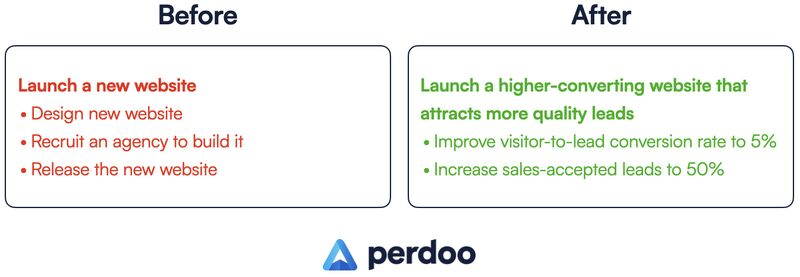
Which team, you think, will be more valuable for an organization: the one that focuses on outputs (left) or the one that focuses on outcomes (right)?
I guess you have to ask yourself: what's really more work? Spending a bit of time learning OKRs, or spending every quarter chasing vague goals that don't guarantee business success?
4. Can't we just use spreadsheets for this?
This one comes up constantly. And I get it. Spreadsheets are familiar, they're free, and your team already knows how to use them. Why pay for a dedicated tool when you have Google Sheets?
If it's just for tracking OKR and your organization is completely new to the framework, then spreadsheets are actually a great way to get started. They let you gain that first experience with the framework without committing to a tool. And they actually work fine as long as you only have a handful of people involved, and a dozen or so OKRs to track.
But they stop working the moment you grow beyond that. Spreadsheets are static. They don't show how team-level OKRs connect to company-level ones, they don't surface progress automatically, and they don't give leadership a real-time view of how the organization is tracking against its strategy.
[.add-bulb][.add-bulb__content]Did you know that Perdoo is also free, up to 5 users? Get your free account here![.add-bulb__content][.add-bulb]
What actually happens in most organizations that stick with spreadsheets is this: someone builds a nicely formatted sheet in Q1, it gets updated diligently for about 3 weeks, and by week 6 half the team has stopped opening it. By Q2 someone suggests starting fresh, and the cycle repeats.
We've seen this with many customers who came to Perdoo after trying the spreadsheet route. The problem isn't discipline. The problem is that spreadsheets weren't built for this. They don't create visibility, they don't facilitate alignment, and they turn what should be a strategic conversation into a data-entry exercise.
A dedicated OKR software gives your goals a permanent, visible home. Everyone can see the company's strategy and objectives, understand how their work connects, and update progress without digging through tabs and rows. That visibility is what makes the difference between OKRs that gather dust and OKRs that drive execution.
5. What if my team resists or loses motivation after the first quarter?
A VP of Operations shared this concern during an onboarding call: "We've tried frameworks before. People are excited for the first few weeks, then it fizzles out. How is this any different?"
I appreciate the honesty in this question because it's a real pattern. Organizations have tried SMART goals, 4DX, OGSM, and plenty of other frameworks before. Most of them fizzle out. OKR has gained way more traction than any of those, and I think the main reason is simplicity. 3 questions: Where do we want to go, How do we measure getting there, and What do we do to get there. That's it.
But even a simple framework can fail if the rollout is wrong. The biggest mistake I see is going all-in on day 1. You introduce Perdoo to the entire company in a single quarter, ask every team to set up their strategy, OKRs, and KPIs, and expect everyone to "get it" immediately. That's a recipe for burnout and backlash.
When it comes to OKR, what works better is a gradual rollout. What works better is a gradual rollout. Start with leadership and 1 or 2 teams. Keep it simple: 1 Objective per team, 2 to 3 Key Results each. Let people experience the rhythm of setting, tracking, and reviewing OKRs before you scale it across the organization. The teams that start first become your internal champions. They share what works, what doesn't, and help onboard the next wave.
The other thing that makes a real difference is embedding Perdoo into existing routines instead of creating new ones. Run your 1-on-1s directly in Perdoo so the conversation is always grounded in real progress on Objectives and KPIs. Use your team meetings for a quick check-in on what's moving and what's stuck. And instead of asking people to build separate progress reports for leadership, let Perdoo handle that. Updates flow automatically as people track their goals, so your superiors always have a clear picture without anyone compiling slides on a Friday afternoon.
A good strategy execution platform should tackle exactly this problem. It should make your strategy visible, your goals easy to track, your meetings more focused, and your reporting effortless, so the whole system doesn't fade into the background after the first quarter. Motivation doesn't come from a launch event. It comes from people seeing their work connect to the bigger picture and watching progress happen in real time.

Ready to get started?
Free for up to 5 people.