
Watch a quick walkthrough or book a demo
Request successful.
Our team will contact you within one business day.
Pick a time that works for you and we'll send the invite.
Oops! Something went wrong while submitting the form.
Sign-up successful!
Check your inbox for a link to activate your free Perdoo account.


Henrik van der Pol
4
min
read
Rather watch a video? Scroll down!
Some OKR enthusiasts have a very strict interpretation of “cascading OKRs”: they expect a Key Result to become an Objective when it’s assigned to someone else. This approach is promoted in John Doerr’s book Measure what matters and in Rick Klau’s famous OKR video. Some OKR software vendors also encourage this way of working.
But it doesn’t take a scientist to understand that this approach doesn’t work. I’ll explain why and will share an alternative approach that does work.
First, Objectives vs. Key Results
Objectives, Key Results, and Initiatives each serve a different purpose. Hence they each have their own set of requirements.
Objectives tell you where to go
An Objective is a qualitative statement that describes the end-state — the outcome you’d like to achieve. They need to be concise and inspiring so that everyone remembers where they’re heading.
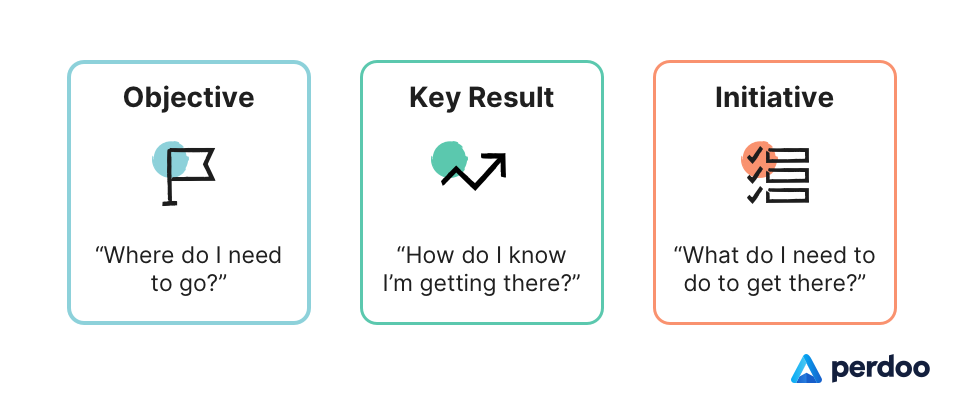
For that reason, Objectives should not contain a metric — your people aren’t going to remember that, and quite frankly neither will it motivate them. Leave it up to the Key Results to make it specific and measurable.
Key Results will let you know if you’re getting there
Key Results kill 2 birds with 1 stone:
- Specify what an Objective means
Qualitative Objectives can be a bit ambiguous, so you need Key Results to quantify the Objective and make it specific. Imagine your Objective is to Become one of the fastest-growing companies in your industry. You could measure this in terms of revenue, number of customers, number of employees, or multiple indicators at once. Whatever you mean by “fastest-growing,” the Key Results will make it clear.
- Measure progress toward the Objective
Key Results are, as Andy Grove, the father of OKR, says: “meant to pace a person—to put a stopwatch in his own hand so he can gauge his own performance.” In other words: the Key Results define whether the Objective has been achieved.
In order to quantify an Objective, or measure progress toward it, a Key Result must contain a metric (see also The anatomy of a Key Result). As Doerr’s OKR formula goes: “I will (Objective) as measured by (Key Results).”
The word measure is encapsulated in the term metric. The word “metric” is derived from the Greek word métron (μέτρον), which means “measure” or “something used to measure”. Simply put, the metric is what makes the Key Result “measurable.”
Virtually everyone, including John Doerr, seems to agree that a Key Result must always contain a metric. Phew!
The metric defines a Key Result’s progress
When a Key Result contains a metric, you don’t get to define progress for the Key Result yourself anymore — you rely on hard facts. Only the (current value of your) metric can and will define progress for your Key Result. It’s the only fact you need!
Let’s say you have an Objective to Improve customer happiness. A Key Result could then be to Increase NPS from 30 to 50. In this case, NPS (Net Promoter Score) is your metric, and you’d have to look at your current NPS score to see what the correct value is for your Key Result.
There are many things that you can do to increase NPS. You could squash bugs in your product, hire extra support agents to bring down your response time, improve your product or service in response to customer feedback, and so on. But doing these things won’t automatically mean NPS will go up. NPS will only go up if more of your users give you a high NPS score and become promoters.
The problem with Key Results turning into Objectives
Everyone agrees that Key Results drive progress for an Objective.
But now if I assign my Key Result, for example, Increase NPS from 30 to 50 to you and want it to become an Objective, your Objective now is: Increase NPS from 30 to 50. It contains a metric (NPS) and will automatically be measurable. As we know it, that’s incorrect.
If you decide to create Key Results for this Objective, these Key Results can’t really drive progress for the Objective. When an Objective or Key Result (or any other goal for that matter) contains a metric, it’s the metric itself that will define its progress.
On the other hand, you may now be tempted to create output, activity-based Key Results for your Objective. And this goes against the fundamentals of OKR, making it an almost futile exercise.
So at this point, we’re stuck. But don’t sweat it, there is a solution.
The solution
Don’t expect Key Results to turn into Objectives when assigned to someone else. In fact, don’t create Key Results at all. Instead, create sub-Objectives (or aligned Objectives) and assign these to the corresponding team and/or person. You can then create Key Results for these sub-Objectives.
This is especially helpful for annual Company Objectives. Because these are often more thematic, it can be difficult to define Key Results for them. Instead of basing their competition on Key Results, you can instead look at the overall progress of all its aligned Objectives.
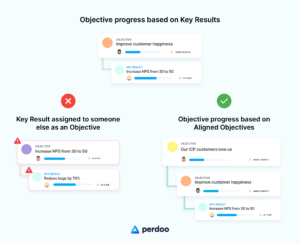
Here’s how that works in practice:
Watch video

Ready to get started?
Free for up to 5 people.