
Sign-up successful!
Check your inbox for a link to activate your free Perdoo account.
Watch a quick walkthrough or book a demo
Request successful.
Our team will contact you within one business day.
Pick a time that works for you and we'll send the invite.
Oops! Something went wrong while submitting the form.


Management by Objectives: The Complete Guide (2026)
4
min
read
Introduction
Setting clear Objectives is key to driving business success. Management by Objectives (MBO) has been a popular framework for decades, helping organizations align individual and company goals. But is MBO still relevant today? In this guide, we’ll break down MBO, explore its advantages and shortcomings, and show how OKR builds upon MBO to offer a better, more modern approach.
What is Management by Objectives?
Management by Objectives (MBO) is not really a goal management framework, but more a philosophy on how to run a company and manage people. MBO believes that you should manage a company by setting Objectives.
These Objectives are measurable and aligned with the organization’s company goals and overarching strategy. This ensures that every team member knows what they need to achieve and how their work contributes to the company’s success. The aim of the framework is to improve the organization's performance.
Within MBO, Objectives usually cascade down from company Objectives to department and team Objectives to Objectives for each individual employee. This enables the entire organization — at all levels — to work toward the higher-level company goals.
Each employee is then responsible for pursuing their own individual objectives, preferably using their very own methods and tools. Often times, rewards and bonuses are linked to the achievement of Objectives.
[fs-toc-omit]Example of MBO in action:
A software company wants to improve customer satisfaction. Using MBO, they set the following objective:
- Objective: Improve customer satisfaction score from 75% to 90%.
- Employee goals: Support team reduces response time from 24 hours to 6 hours, and product team fixes top 10 user-reported bugs within the quarter.
Is MBO right for you?
Not every organization will benefit equally from Management by Objectives. MBO can be highly effective in some environments and cumbersome in others. To determine if MBO is a good fit for your company, consider the following factors:
- Company size: MBO tends to shine in larger organizations with multiple layers of management. The framework’s structured goal cascade provides alignment from the C-suite to frontline employees, which is invaluable when you have hundreds or thousands of staff. Many large companies (including General Electric and Hewlett-Packard) have successfully used MBO to set clear goals and track performance. In a small business or startup, however, a formal MBO program might feel like overkill. Smaller teams often communicate and align naturally; introducing heavy processes could slow them down without adding much value.
- Management style: Think about how your leadership team manages and communicates goals. MBO was developed in a more top-down management era, and it works best when leaders set clear objectives for others to execute. If your management style is very structured and directive – for example, if you prefer setting specific targets for each department and measuring success by objective completion – MBO aligns well. On the other hand, if your organization embraces a more agile or collaborative style (where employees help set goals or you pivot frequently), MBO’s rigidity may clash with that approach. An overly rigid, results-focused MBO program can even discourage innovation if managers and employees feel they can’t deviate from pre-set objectives.
- Company culture: Your culture plays a big role in whether MBO will thrive. MBO emphasizes individual accountability and goal achievement, which fits well in cultures that value discipline, clarity, and reward hitting targets. If your culture already encourages employees to take ownership of specific metrics or projects, MBO can reinforce that. However, in very collaborative or cross-functional cultures, be cautious – a strict MBO system can inadvertently create silos, with people fixating on their own objectives at the expense of teamwork. Likewise, MBO doesn’t inherently promote transparency across teams; objectives are often siloed between a manager and their direct report. If open communication and shared goals are core to your culture, you’d need to deliberately introduce transparency into the MBO process (or consider a framework like OKR that naturally emphasizes it). In short, ensure your culture can balance individual goal accountability with the collaboration you want to maintain.
- Strategic clarity: MBO is most effective when your company has a clear long-term strategy and stable priorities. Because MBO objectives typically cascade down from the top and are often set annually or quarterly, they require a steady aim. If you have well-defined strategic goals that aren’t likely to change soon, MBO provides a great mechanism to translate that strategy into departmental and individual objectives. In a stable environment, this keeps everyone focused on what matters. But if your strategy tends to shift frequently or your industry is very fast-paced, MBO may struggle to keep up. Objectives set at the beginning of the year can become obsolete if the market or company direction changes mid-year. In fact, MBO works best in stable environments with clear objectives, whereas rapidly changing or innovative companies may need a more flexible approach. For example, a hardware manufacturing firm with a steady three-year plan might leverage MBO effectively, whereas a tech startup pivoting every few months might find a rigid annual MBO plan too constraining.
- Leadership engagement: One critical success factor for MBO is the commitment of your leadership. Ask yourself: will executives and managers actively champion the MBO process? MBO is not a “set and forget” framework – it requires leaders to set clear objectives, communicate them, and regularly review progress. If top management isn’t fully on board or willing to lead by example, an MBO program can fizzle out quickly. Successful implementation of MBO requires active support from organizational leaders who champion the approach. This means leadership must consistently communicate the importance of the objectives, provide resources or tools for tracking them, and hold themselves accountable just as much as their teams. If your leadership team is ready to invest time in goal-setting and review meetings, and to tie management processes (like performance reviews or bonuses) to MBO outcomes, then MBO is more likely to deliver results. Without that engagement, even a well-designed MBO system won’t be worth the effort, as employees take their cues from the top.
- Goal-setting maturity: Consider your organization’s experience with formal goal-setting or performance management frameworks. If you currently have no structured goal-setting process in place, introducing MBO can be a big change. The good news is it will bring discipline and clarity – moving you away from vague goals to specific, agreed-upon objectives. But there may be a learning curve: managers and employees will need training to write good objectives and track them, and you’ll want to start with simple, achievable goals to build confidence. If your company is early in its goal-setting maturity, ensure you have the capacity to coach teams through the MBO process. On the flip side, if you already use a modern goal framework (like OKRs or another system) or have a robust performance management routine, adding MBO on top might be redundant or even conflicting. For instance, companies that have adopted OKRs (which evolved from MBO) value the agility and frequent check-ins that OKRs provide. In such cases, switching back to a strict MBO approach could feel like a step backward in flexibility. Assess whether MBO would enhance your current goal processes or simply duplicate them. If you have a high “goal-setting maturity” – meaning teams are already good at setting, tracking, and adapting goals – you might only adopt MBO if it clearly addresses a gap that your current system doesn’t.
If most of the factors above align positively (e.g. you’re a mid-to-large company with a clear strategy, supportive leadership, and a culture that appreciates clear objectives), then MBO is likely worth trying.
You’ll benefit from the alignment, accountability, and focus that MBO brings. However, if several of these conditions don’t hold – say your environment is very dynamic, your culture prizes flexibility, or leaders can’t commit the time – then MBO may not deliver the value you want. In that case, a more adaptable goal-setting framework might be a better choice. Many modern organizations opt for frameworks like OKRs as a more agile evolution of MBO, especially when they need frequent goal revisions and greater transparency across teams. Ultimately, the key is to choose a system that fits your company’s size, style, and strategic needs. By evaluating your company against these factors, you can confidently decide whether implementing MBO will drive you forward or if another approach makes more sense.
The history of MBO
The concept of MBO was first introduced by U.S. economist Peter Drucker in his 1954 book The Practice of Management. Drucker emphasized the importance of setting clear, achievable goals that are agreed upon by both managers and employees. At the time, it was a revolutionary concept! MBO quickly gained popularity as a structured way to drive business performance, particularly in large organizations.
One of the most influential adopters of MBO was Andy Grove, former CEO of Intel. Grove implemented MBO at Intel and further developed it into what we now know as OKRs (Objectives and Key Results). He refined the framework to make it more agile, emphasizing measurable outcomes and regular progress reviews. His approach was later detailed in his book High Output Management, which became a foundational text for modern goal-setting methodologies.
Grove’s adaptation of MBO into OKRs influenced many successful companies, including Google, which popularized OKRs as a key driver of innovation and growth.
How MBO works
MBO follows a structured five-step process that ensures goals are clearly defined, aligned with the company’s strategy, and regularly reviewed. Below is a detailed breakdown of each step.
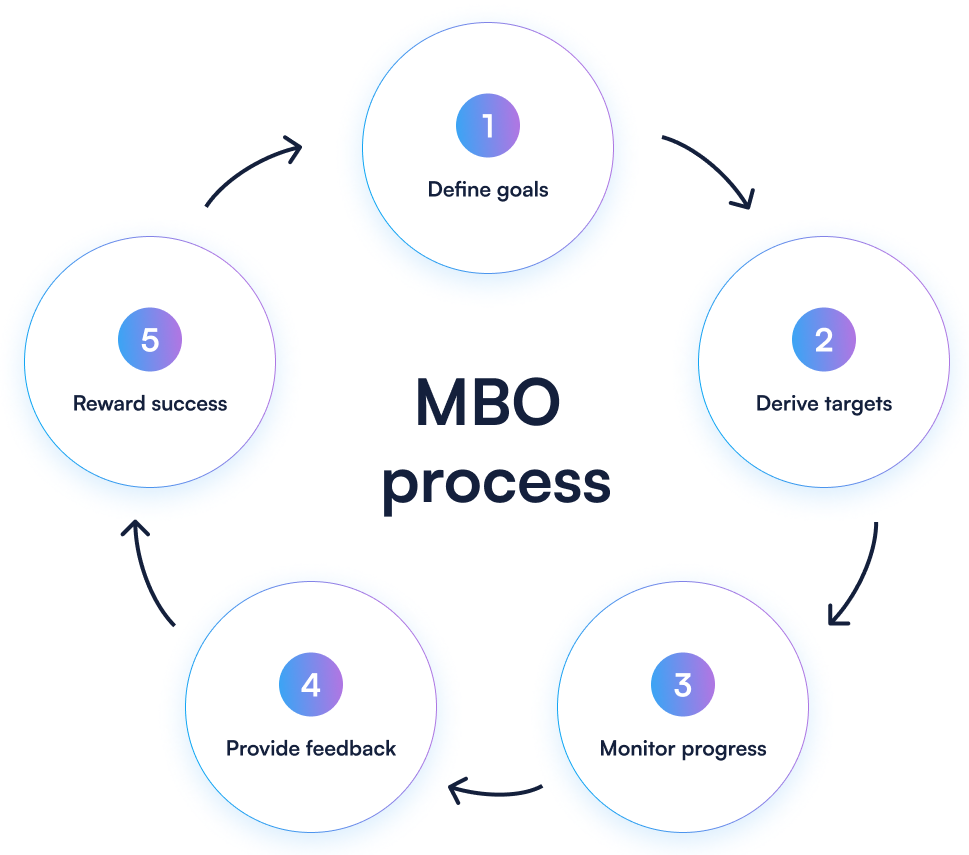
1. Define objectives
The first step in MBO is setting clear, specific, and measurable objectives. These objectives should be directly linked to the company’s broader goals and should be designed to drive meaningful impact. Effective objectives follow the SMART criteria:
- Specific – Clearly defined and unambiguous.
- Measurable – Includes quantifiable targets.
- Achievable – Realistic and attainable within a given timeframe.
- Relevant – Aligns with the company’s mission and strategy.
- Time-bound – Has a defined deadline for completion.
Example: Instead of setting a vague goal like “increase sales,” a SMART objective would be: “Increase quarterly sales revenue from $500,000 to $700,000 by the end of Q3.”
2. Align objectives with company strategy
Once objectives are defined, they must be aligned with the company’s overall strategic priorities. This ensures that every department and employee is working toward a common goal. Managers should communicate how individual objectives contribute to the organization’s mission and long-term vision.
Example: If a company’s strategic goal is to expand into new markets, the marketing department may set an objective to increase brand awareness in a specific region, while the sales team sets an objective to secure a certain number of new customers in that market.
3. Collaborate on goal setting
MBO is most effective when employees are actively involved in setting their own objectives. This fosters a sense of ownership and motivation. Managers and employees should engage in open discussions to:
- Ensure objectives are realistic and meaningful.
- Align individual goals with team and company-wide objectives.
- Identify potential challenges and how to overcome them.
Collaboration helps employees feel invested in their work and improves engagement. It also ensures that objectives are not just top-down directives but are co-created based on real-world insights.
4. Monitor progress
Setting objectives is just the beginning—regular progress tracking is crucial for success. Managers should schedule periodic check-ins (e.g., weekly, monthly, or quarterly) to assess performance, provide feedback, and make adjustments if necessary.
Key activities in this step include:
- Reviewing key performance indicators (KPIs) to measure progress.
- Identifying obstacles that may be hindering goal achievement.
- Adjusting objectives if business conditions change.
- Recognizing and celebrating small wins to keep employees motivated.
Example: If a sales team is behind on its target, a mid-quarter review might reveal that a new competitor has entered the market. The team can then adjust its strategy, such as focusing on a different customer segment or refining its pricing approach.
5. Evaluate performance
At the end of the objective cycle, managers and employees review the results. This evaluation determines whether the objectives were met and what lessons can be learned for future goal-setting. The performance review should:
- Compare actual results against initial targets.
- Analyze factors that contributed to success or failure.
- Identify areas for improvement in the next cycle.
- Provide constructive feedback and recognition.
Performance evaluations should focus not only on whether the objective was achieved but also on how the process can be refined for future success. This step helps organizations continuously improve their goal-setting framework.
Challenges & limitations of MBO
While Management by Objectives (MBO) can be an effective framework for setting and achieving goals, it comes with its own set of challenges and limitations.
- Rigidity: One key issue is its rigidity—MBO is often criticized for being too structured and static, making it difficult for organizations to adapt to changing business environments. Because objectives are typically set annually, they may become outdated as market conditions shift. The process can become too slow for today's fast-paces business world.
- Emphasis on individual goals: Another limitation is its strong emphasis on individual goals, which can sometimes lead to siloed thinking rather than encouraging cross-functional collaboration. Employees may prioritize their own objectives over collective organizational goals, leading to inefficiencies.
- Focus on outputs: MBO also focus more on outputs than on outcomes. As a consequence, it results in empoyees prioritizing the completion of tasks rather than driving real business impact.
- Results-over-process: Additionally, MBO can sometimes foster a results-over-process mindset, where achieving the objective is prioritized over learning and innovation. This may discourage experimentation and adaptability, which are crucial in today’s fast-paced business landscape.
- Lack of transparency: Lastly, because transparency and alignment aren't emphasized within the MBO framework, it lacks the collaborative and transparent nature of modern goal-setting frameworks.
Benefits of MBO
Despite its limitations, MBO offers several advantages that make it a valuable management approach.
Here are the 4 most important benefits:
- Goal alignment: MBO ensures that individual objectives align with broader company goals, creating a unified direction for the entire organization. This alignment helps employees see how their work contributes to overall business success, fostering a sense of purpose and cohesion.
- Employee engagement: By involving employees in setting their own objectives, MBO encourages greater ownership and commitment. When employees have a say in their goals, they are more motivated to achieve them, leading to higher job satisfaction and productivity.
- Improved performance tracking: MBO relies on well-defined objectives and measurable targets, making it easier to track progress. Managers can use these metrics to provide constructive feedback, identify areas for improvement, and recognize achievements, ultimately leading to a more effective performance management process.
- Accountability: Clear expectations and defined objectives help employees stay focused on their tasks and responsibilities. When individuals know exactly what is expected of them and how success is measured, they are more likely to stay accountable and deliver better results.
How to implement MBO successfully
Implementing Management by Objectives requires thoughtful planning and deliberate action. Here’s a practical, step-by-step guide to successfully embedding MBO into your organization:
Step 1: Secure executive commitment
Leadership must clearly commit to using MBO, communicating its benefits and purpose to the entire organization. Hold executive briefings to ensure alignment and clarify expectations. Leadership should visibly endorse the process to foster buy-in.
Tip: Consider hosting an initial executive workshop to agree on the strategic goals and how MBO fits your organization's broader strategy.
Step 2: Define organizational Objectives
Clearly articulate your top-level organizational Objectives based on your strategic goals. Objectives should be Specific, Measurable, Achievable, Relevant, and Time-bound (SMART).
Example: Instead of “increase sales,” specify “increase annual sales revenue by 15% by the end of Q4.”
Step 3: Cascade Objectives
Break down organizational Objectives into departmental and individual Objectives, ensuring alignment at all levels. Managers should collaboratively set objectives with their teams, ensuring clarity and mutual agreement.
Tip: Use joint planning sessions to ensure individual Objectives clearly support department goals, fostering ownership and accountability.
Step 4: Develop clear action plans
Create detailed action plans specifying how each Objective will be achieved, including key milestones, responsibilities, and deadlines. Action plans should be collaborative, developed with input from employees to ensure feasibility and buy-in.
Example: If the Objective is to enhance customer satisfaction by 20%, the action plan might include launching customer feedback initiatives, conducting training, and regularly reviewing customer satisfaction scores.
Step 5: Establish clear measurement and monitoring systems
Set clear metrics to track progress and determine Objective achievement. Implement regular review meetings (monthly or quarterly) where managers and employees discuss progress, challenges, and adjustments.
Tip: Utilize dashboards or performance management software to visualize progress and maintain transparency.
Step 6: Conduct performance reviews
Schedule formal performance reviews at defined intervals (quarterly, bi-annually, or annually) to evaluate achievements against objectives. Reviews should involve open dialogue, recognizing successes, addressing challenges, and adjusting Objectives as needed.
Example: A structured performance conversation could involve discussing achieved results, lessons learned, and agreeing on modifications to future Objectives based on performance outcomes.
Step 7: Provide feedback and rewards
Reinforce MBO success through consistent feedback and recognition. Tie achievements to rewards or incentives clearly aligned with Objectives to strengthen motivation and engagement.
Tip: Align bonuses, promotions, or recognition programs explicitly with Objective achievement to embed accountability and enhance motivation.
Step 8: Iterate and refine
Continuously assess and refine your MBO process based on feedback and performance results. Solicit input from participants regularly and adapt your system to maintain relevance and effectiveness.
Example: After your first MBO cycle, host a feedback session to capture insights from employees and managers, then apply this feedback to streamline and enhance future MBO processes.
Implementing MBO effectively requires consistency, transparency, and genuine engagement at all organizational levels. Following these detailed steps will help you successfully embed a results-oriented culture that leverages the full potential of Management by Objectives.
How does MBO compare to OKR?
MBO and OKR are closely related — OKR evolved directly from MBO through Andy Grove's work at Intel in the 1970s. Both frameworks share the same core principle: define clear objectives and measure progress against them. But they differ in important ways that affect how well they work in practice.
Goal structure
In MBO, you set objectives and then evaluate whether they were achieved. The objective itself is typically the only formal element — there's no built-in structure separating what you want to achieve from how you'll measure success.
OKR explicitly separates the two: the Objective describes the qualitative goal (what you want to achieve), while Key Results define the measurable outcomes that prove you got there. This separation forces teams to think carefully about what success actually looks like in measurable terms.
Cadence
MBO traditionally operates on annual cycles. Objectives are set at the beginning of the year and reviewed at the end. This works in stable environments but creates problems when priorities shift mid-year.
OKR uses quarterly cycles. Every three months, teams set new OKRs based on current priorities, review what they learned, and adjust. This shorter cycle means goals stay relevant and teams can respond to changes without waiting for the next annual planning round.
Direction of goal-setting
MBO is typically top-down. Senior leadership defines objectives, and these cascade down through the organization. Employees participate in defining their individual objectives, but the strategic direction flows from the top.
OKR uses a mix of top-down and bottom-up. Company-level OKRs provide strategic direction, but teams and individuals also propose their own OKRs based on what they believe will have the most impact. This creates stronger ownership and surfaces ideas from people closest to the work.
Transparency
MBO goals are usually private — shared between a manager and their direct report as part of performance management. Other teams rarely see what their colleagues are working toward.
OKRs are transparent by default. Everyone in the organization can see everyone else's OKRs, from the CEO to individual contributors. This visibility makes alignment easier and helps teams avoid duplicating effort or working at cross-purposes.
Link to Performance Reviews
MBO is closely tied to performance evaluation and compensation. Achieving your objectives directly affects your performance rating, bonus, or promotion. This creates accountability but can also lead to sandbagging — people set conservative objectives they know they can hit.
OKR intentionally separates goal-setting from performance evaluation. Teams are encouraged to set ambitious OKRs, and achieving 70% of a stretch goal is often considered a success. Performance reviews still happen, but they consider OKR progress as one input alongside other factors, not as a direct scorecard.
Comparison table
Which should you choose?
MBO can work well for organizations in stable industries with predictable planning cycles, where objectives don't change significantly throughout the year. It's also familiar to many HR teams and integrates naturally with traditional performance review processes.
OKR is better suited for organizations that need to adapt quickly, want to foster transparency and collaboration, or are finding that annual goal-setting doesn't keep pace with their market. Many organizations that start with MBO eventually transition to OKR as they look for more agility in their goal-setting process.
Perdoo supports both frameworks. Whether you're running MBO, OKR, or transitioning from one to the other, the platform connects your goals to your strategy so everyone can see how their work contributes to the bigger picture. Learn more about OKR.
Conclusion
MBO was a breakthrough in goal-setting when it was introduced, but it has limitations in today’s fast-moving business world. OKRs build on MBO’s foundation while improving flexibility, collaboration, and outcome-driven thinking. For organizations looking to improve goal-setting and performance management, OKRs are the modern evolution of MBO that better align with today’s business needs.
FAQ
What is MBO (Management by Objectives)?
MBO is a strategic management framework where managers and employees collaboratively define clear, measurable objectives that align with the organization's goals. Developed by Peter Drucker in the 1950s, MBO emphasizes setting specific targets, tracking progress, and evaluating results over a defined period — typically annually or quarterly.
What are the key steps in the MBO process?
The MBO process follows five steps: (1) define organizational objectives, (2) translate them into departmental and individual goals, (3) monitor progress through regular check-ins, (4) evaluate performance against the agreed objectives, and (5) reward or adjust based on results. Success depends on genuine collaboration between managers and employees during goal-setting.
What are the advantages of MBO?
MBO provides clear direction by connecting individual work to organizational strategy. It increases accountability through measurable objectives, improves manager-employee communication through collaborative goal-setting, and creates a structured basis for performance evaluation. Companies like Hewlett-Packard and Intel have credited MBO with improving organizational focus.
What are the disadvantages of MBO?
MBO can become rigid and bureaucratic, especially in fast-moving environments where annual objectives become outdated. It tends to focus on individual goals over team collaboration, and the emphasis on measurable targets can lead to gaming or neglecting important work that's harder to quantify. Implementation also requires significant management time and commitment.
What is the difference between MBO and OKR?
Both MBO and OKR are goal-setting frameworks, but they differ in structure and cadence. MBO typically uses annual cycles with objectives set top-down, while OKR uses quarterly cycles with a mix of top-down and bottom-up goal-setting. OKRs separate the objective (qualitative goal) from key results (measurable outcomes), and emphasize transparency — OKRs are usually visible across the entire organization, whereas MBO goals are often private between manager and employee.
Is MBO still used today?
Yes, many organizations still use MBO or frameworks heavily influenced by it. However, the trend has shifted toward more agile goal-setting approaches like OKR, which address some of MBO's limitations around rigidity and cadence. Many companies that used MBO have evolved their practice by adopting shorter review cycles and greater transparency — principles that are central to OKR.

Ready to get started?
Free for up to 5 people.