
Watch a quick walkthrough or book a demo
Request successful.
Our team will contact you within one business day.
Pick a time that works for you and we'll send the invite.
Oops! Something went wrong while submitting the form.
Sign-up successful!
Check your inbox for a link to activate your free Perdoo account.


Henrik van der Pol
5
min
read
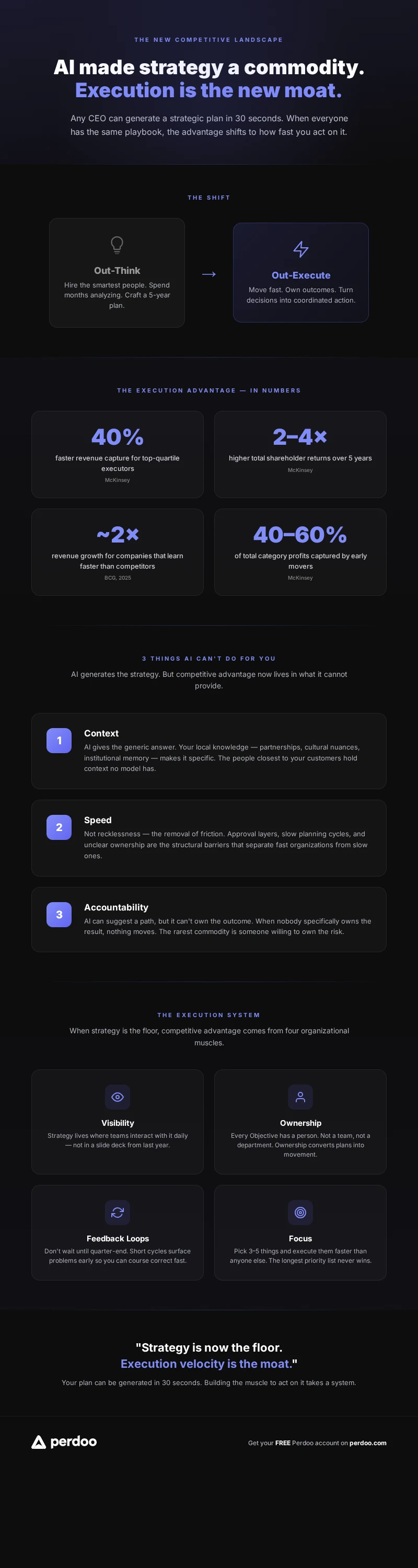
Key Takeaway: AI is making strategic thinking available to everyone. When every company can generate the same "right" strategy, the competitive advantage shifts entirely to execution speed, organizational alignment, and accountability.
For decades, strategy was the moat. You hired the smartest people, spent months analyzing the market, crafted a winning strategy, and then built a 5-year plan that was supposed to give you an edge. The belief was that whoever out-thinks the competition wins.
That's changing fast. When any CEO can ask ChatGPT, Gemini, or Claude to analyze their market, identify opportunities, and draft a strategic plan in 30 seconds, the plan itself stops being a differentiator. It becomes a baseline. Your competitor can generate the same plan using the same models trained on the same data. Faisal Hoque calls this "strategic convergence": the phenomenon where AI-assisted strategies start to look identical across companies because everyone is drinking from the same conceptual fountain.
This changes the role of leadership more than most executives realize. You're no longer the architect of the plan. You're the person responsible for making the plan happen.
The plan is free. Moving on it isn't.
AI can give you a great strategy map at the speed of light, but most organizations still execute their strategies at walking pace. Forbes recently coined the term "execution velocity" to describe the rate at which an organization transitions from identifying opportunities or threats to taking coordinated, measurable action. And the data on this is striking: McKinsey found that companies in the top quartile for execution speed capture revenue opportunities 40% faster and generate 2 to 4x higher total shareholder returns over 5 years.
The gap isn't about having better information. Everyone has access to that now. The gap is about how quickly you can turn that information into coordinated action across your organization.
In my experience, this is where most companies struggle. Not because they lack ambition or talent, but because their organizational design wasn't built for speed. You have 3 layers of approval needed to pivot a budget. You have strategic priorities that were set two years ago and haven't been revisited since. You have teams executing work that doesn't connect to anything.
3 things AI can't do for you
AI can generate the strategy. But there are 3 things it cannot provide, and these are exactly where the competitive advantage now lives.
Context
If every CEO uses the same models, everyone arrives at roughly the same logical conclusion. That's the convergence problem. What AI can't see is the local context: the long-term partnership that's worth more than a quarterly optimization, the cultural nuance that makes a particular market different, the institutional knowledge that says "we tried this in 2019 and here's what actually happened."
True strategic differentiation now comes from the courage to lean into the human judgment that a probability model can't replicate. AI gives you the generic answer. Your context makes it specific.
This is also why your strategy needs to be visible across the organization, not locked in a leadership team's heads. The people closest to your customers, your product, and your operations hold context that no AI model has access to. But they can only contribute that context if they can see the strategy and understand where their judgment matters.
Speed
A 2025 BCG report found that companies that learn faster than their competitors experience nearly 2x the revenue growth over time, and the gap keeps widening. McKinsey's research shows that early movers capture between 40 and 60% of total category profits.
Speed isn't about being reckless. It's about removing the friction that slows down coordinated action. The 3 approval layers, the quarterly planning cycles that take weeks, the unclear ownership that means nobody acts until someone explicitly tells them to. These are the structural barriers that separate fast organizations from slow ones.
And this is where most companies lose. Not in the quality of their strategy, but in the time it takes to get from "we've decided" to "we're doing." When that gap stretches from days into months, the window of opportunity closes before you've even started moving.
Accountability
AI can suggest a path, but it can't own the outcome. It can't look shareholders in the eye and take responsibility for a bet that didn't pay off. In an era where any model can give you a confident-sounding answer (some of which are hallucinations), the rarest commodity is someone willing to own the risk and drive it to completion.
I've seen this with many customers. The strategy exists. The priorities are clear. But nobody specifically owns the outcome. And when nobody owns it, nothing moves.
This is exactly why execution systems matter
The pattern here is consistent with what we've been saying at Perdoo for years: The plan is not the hard part. Making it happen is.
When strategy becomes a commodity, the competitive advantage shifts to 3 things: how visible your priorities are across the organization, how clearly they're owned, and how fast you can see whether they're working and course correct when they're not.
Your strategy lives in the same place as your execution. Not in a slide deck from January last year. In a system that your teams interact with every day. When your strategy, OKRs, and KPIs all live in one place, everyone can see what the company is trying to achieve and how their work connects to it.
Every Objective has an owner. Not a team, not a department. A person. When the competitive advantage is speed, you can't afford the delay that comes from unclear accountability. Ownership is what converts a plan into movement.
Feedback loops are short. You don't wait until the end of the quarter to find out your strategy isn't working. You run your 1-on-1s and team meetings in Perdoo, grounded in real progress on Objectives and KPIs. Progress reporting flows automatically as people update their goals. Leadership has a clear view at all times, without anyone manually compiling it.
Focus is enforced. OKRs limit you to a handful of Objectives per cycle. When every competitor has access to the same strategic insights, the companies that win aren't the ones with the longest list of priorities. They're the ones that pick 3 to 5 things and execute them faster than anyone else.
The new competitive advantage
Strategy is now the floor, execution velocity is the moat.
If your brilliant strategy can be generated by a model in 30 seconds, the plan is no longer your edge. Your edge is the organizational muscle to act on it, quickly, with clear ownership, visible priorities, and short feedback loops.
That muscle doesn't build itself. It requires a system, a place where strategy, goals, and day-to-day execution are connected, visible, and moving at the same speed as the decisions you're making.
That's what strategy execution software like Perdoo helps you build. Not another planning tool. An execution system that makes your organization fast enough to compete when the strategy itself is no longer the edge.

Ready to get started?
Free for up to 5 people.